Update on Russian Ban on Intercountry Adoptions to the United States


russia_flag

Following the January 22, 2013 Russian Supreme Court Letter on Implementation of Federal Law No. 272-FZ, CCAI has continued to work closely with Members of Congress and our partners inside Russia.  In situations like these, CCAI’s priority is to ensure that the U.S. government is aware of all individuals directly impacted and have the information necessary to act on their behalf.  The following are actions that have occurred since our last update:

House Resolution 24: Expressing the deep disappointment of the House of Representatives in the enactment by the Russia Government of a law ending inter-country adoptions of Russian children by United States citizens…

  • Introduced on January 14, 2013 by Congressional Coalition on Adoption Co-Chairs Representatives Michele Bachmann and Karen Bass.
  • House Resolution 24 language matches that of Senate Resolution 628 (introduced in the 112th Congress on Dec. 30, 2012).

January 17, 2013 House Letter to President Putin  

  • Led by Representatives Chris Smith and Michael Fitzpatrick, 46 U.S. Representatives signed a letter to President Putin appealing to him for humanitarian reasons to not apply the January 1, 2013 ban of adoptions of Russian children to the United States to those several hundred adoptions already in process when the ban was enacted.
  • Noted that many of the children who are impacted by the ban on adoptions already know their U.S. adoptive families and have even recently been visited by them.
  • Encouraged President Putin to work together with the U.S. to “ensure that children are moved from institutions to family care.”

January 18, 2013 Bicameral Letter to President Putin

  • Led by Senator Blunt and CCA Co-Chairs Senators Landrieu and Inhofe and Representatives Bachmann and Bass, 72 Members of Congress signed this letter to President Putin requesting that the Russian Federation allow the processing of the pending adoptions of children already matched in 2012 to U.S. families.
  • Noted that many of these children have special needs, and “many believed they were soon going to become a part of a safe, permanent and loving family.”
  • Appealed to the spirit of the bilateral adoption agreement the two countries entered into on November 1, 2012 to provide orphaned children with safe and loving homes.

January 18, 2013 Bicameral Letter to President Obama

  • Led by Senator Blunt and CCA Co-Chairs Senators Landrieu and Inhofe and Representatives Bachmann and Bass, 73 Members of Congress signed this letter to President Obama.
  • Noted that Russia’s Ministry of Science and Education estimates over 110,000 children in Russia are living in institutions, with only 7,400 adopted by Russian families annually.
  • Appealed to President Obama to work to reverse the ban, but also to prioritize in the United States’ discussions with Russia in the coming weeks the estimated 350-500 active adoption cases with Russian children.

January 14, 2013 Russian Response Letter to December 21, 2012 Congressional Letter to President Putin

  • On January 14, Ambassador-at-Large Konstantin Dolgov – Russian Foreign Ministry’s Special Representative on Human Rights, Democracy and the Rule of Law – responded to a December 21, 2012 letter from 16 Members of Congress in an immediate response to the news of what was then a potential ban of adoptions from Russia to the United States.
  • Ambassador Dolgov’s letter stated that “[a]ccusations that Russia has violated the [U.N. Convention on the Rights of the Child] by adopting the Dima Yakovlev Law are absolutely ungrounded” and are instead aimed at prioritizing domestic adoptions in Russia.  Suggesting that abuse of Russian children by American families has regularly occurred recently, and “the openly inactive attitude of competent U.S. agencies towards these issues has provoked a particular indignation and incomprehension in the public opinion, political and parliamentary circles in Russia.”  In response to appeals to the November 1, 2012 bilateral adoption agreement between the two countries, the letter states, “in practice we see that the U.S. side is actually sabotaging the provisions of the document.”  “The decision taken by the Federal Assembly of the Russian Federation to ban the adoption of Russian children to the U.S. was a difficult but necessary measure provoked by a consistently non-constructive position of the U.S. federal and local authorities.”

For more information, please visit CCAI’s Russia Page on our website, see the “Russia Bans Adoptions to the United States” section of our January 15, 2013 Legislative Update,
U.S. State Department Releases FY 2012 Annual Report on Intercountry Adoptions

As required by the Intercountry Adoption Act, passed by Congress in 2000, the U.S. State Department recently sent its FY 2012 Annual Report on Intercountry Adoption to the Hill. According to the report, the total number of intercountry adoptions to the US in 2012 has dropped to 8,668, as compared to 9,320 in FY 2011. This decline, which has been a trend in recent years, is the result of several factors.

First, countries that have been longtime partners with the United States in international adoption have experienced significant reductions in the number of children adopted by United States Citizens.  For instance, in 2005, 14,493 Chinese children were adopted by US families as opposed to 2,697 adoptions in 2012.  Similarly, in 2004 Russian adoptions peaked at 9,425, compared to 748 last year and Korea dropped from 2,287 US adoptions in 2003 to 627 in 2012.

Secondly, several countries, that at one point had significant numbers of children being placed with families in the United States, have closed their international adoption programs altogether. In 2007, the year that the Guatemalan Congress passed its international adoption reform legislation, there were 4,844 adoptions of Guatemalan children by US families and in the same year, Vietnam, which has also since suspended adoptions, placed 1,692 of their children with families the United States.  Cambodia, which has been closed to international adoption since 2001, was at the time one of the top ten countries, with 800 children a year being adopted by US families.

In either case, the declines are attributable to one of two things, or a combination thereof.  First, countries such as Korea, China, and Russia have made sincere efforts to increase the number of children adopted domestically in their respective countries.  There is also some evidence to suggest that the number of children being abandoned in these countries has declined. Secondly, there has been a tremendous amount of pressure put on developing countries to shut down their international programs to prevent or guard against fraudulent or corruptive practices in the adoption process.

There are some other trends that are worth noting. Four out of five of 5 of Hague compliant countries that facilitated the most adoptions, reported having average processing times of over a year, with India reporting 606 days being needed to complete a case.  Given the importance of a strong and reliable connection to a family for a child of any age, it is worth looking at if there are ways to appropriately shorten these timeframes.

And there is a bit of good news.  According to the US State Department, 99 US born children had their dream of a family fulfilled by a family outside of the United States, an increase from last year (73).  The report notes that the majority of these families are in Ireland, Netherlands and Canada.  What this shows is that the United States is committed to looking anywhere in the world to find a safe and loving home for its children.

So what does all this mean?  First off, it is important to remember that there is no such thing as an “ideal” number of international adoptions.  While international adoption is an important tool for countries to use in reducing the number of children living outside of family care, it is not always the best or most appropriate option for every child.  That being said, there is an ideal number of children living outside the care and protection of a family; ZERO.

CCAI hopes that the recently released report and others like it will serve as evidence of the need for the US government to take the lead in the effort to reduce the number of children living outside of family care and will continue to support the efforts of federal policy makers to move us in this direction.


FY 2012 Annual Report on Intercountry Adoption

The five countries that facilitated the most intercountry adoptions into the U.S. in FY 2012:

Country FY 2012 (# of incoming cases) FY 2011 (# of incoming cases)
China 2,697 (31% of all intercountry adoptions) 2,589
Ethiopia 1,568 (18%) 1,727
Russia 748 (9%) 970
Korea 627 (7%) 736
Ukraine 395 (4.5%) 632

The 5 Countries that comply with the Hague convention that facilitated the most adoptions, average number of days to completion, and median adoption fees per country in FY 2012:

Country FY 2012 (incoming cases) Average days to completion Median adoption fees
China 2,309 267 $15,600
Columbia 180 403 $18,300
India 153 606 $14,600
Bulgaria 121 388 $13,140
Philippines 118 400 $8,500

The Total number of outgoing intercountry adoptions from the U.S. in FY 2012:

FY 2012 FY 2011
99 cases 73 cases

The three countries with the highest number of intercountry adoptions from the U.S. in FY 2012:

Country FY 2012 (# of outgoing cases) FY 2011 (# of outgoing cases)
Canada 41 31
Netherlands 28 27
Ireland 14 5


US Senate Responds to Russian Law Banning Adoption of Russian Children by American Families

Late last night, the United State Senate unanimously passed S. Res. 628, a resolution expressing the body’s disappointment over the recent passage of a Russian law banning the adoption of Russian children by American citizens.  This resolution, the most recent step in a long series of actions taken by Members of Congress, expresses the Senators’ deep concern with the law, which would deprive a significant number of Russia’s 740,000 institutionalized children their chance of finding a permanent, loving family.

“Given the immensity of the challenges facing the Russian government, one would think they would be taking every possible action to decrease the number of Russian children living without families,” said Kathleen Strottman, Executive Director of the Congressional Coalition on Adoption Institute (CCAI). “Sadly, it is the Russian children, many of whom have spent their entire childhood in institutions, who will suffer the most because of this law.”

The Congressional Coalition on Adoption Senate Co-chairs, Senator Mary Landrieu (D-LA) and Senator Jim Inhofe (R-OK), echoed Strottman’s sentiments.

“Whatever issues our two governments may be facing, there is no political reason to put vulnerable children in the middle of political posturing,” Landrieu said. “Children should be raised by parents, not in orphanages, institutions or alone on the street.”

“It is extremely unfortunate and disheartening that the Russian Duma and President Putin would choose to deprive the children, the very children that they are entrusted to care for, the ability to find a safe and caring family that every child deserves,” Inhofe said.  “As a grandparent of an internationally adopted child, I know that this new law is against the interests of the Russian people, in particular Russian children.  The law continues the disturbing anti-American trend that has been taking place in Russia for the past several years.  It is nothing more than a political play against the United States that ultimately leads to greater hardships and more suffering for Russian children who will now be denied a loving family.”

Since learning of the possible ban, CCAI has been deeply engaged in supporting this and other opposition efforts by Members of Congress.  Earlier this month, CCA Members of Congress sent a bi-partisan letter to President Putin urging him to veto the legislation. “We fear that this overly broad law would have dire consequences for Russian children,” they wrote. “Nothing is more important to the future of our world than doing our best to give as many children the chance to grow up in a family as we possibly can.”

Now that the ban has been enacted, CCAI continues to work with the State Department and Members of Congress to urge the Russian government to grant clemency for cases already in progress. In situations like these, CCAI’s priority is to ensure that US government officials  are not only aware of the personal circumstances of all American families directly impacted but also have the information necessary to effectively advocate on their behalf.  CCAI strongly encourages families that are affected to accommodate the State Department Office of Children’s Issues request for information regarding where they are in the adoption process. The State Department has requested that families email Russiaadoption@state.gov with the subject line: “Intercountry adoption in Russia – family update.”

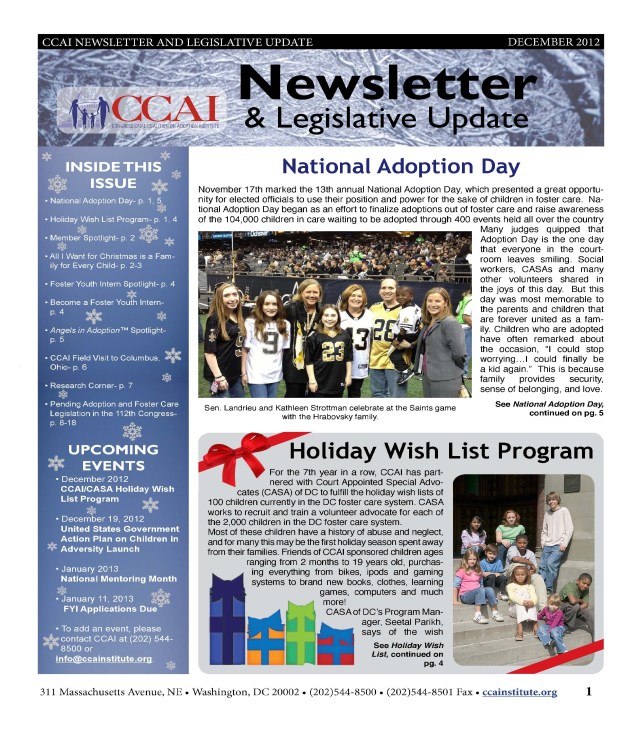
CCAI Holiday Newsletter Available Now!

December 2012_Page_01

The Congressional Coalition on Adoption Institute’s Holiday Newsletter is available here.

Highlights include:

  • National Adoption Day 2012
  • CCAI/CASA Holiday Wish List Program
  • Kathleen Strottman: All I want for Christmas is a Family for Every Child 
  • CCAI Field Visit to Columbus, Ohio

Please note the pending adoption and foster care legislation is included on pages 8-18 and upcoming events are listed on page one.

During this holiday season, we are once again reminded of the important role family plays in our lives. On behalf of all of us at CCAI, thank you for supporting us as we work to ensure that every child has their right to a family realized.

Happy Holidays!

How Adoption Changed My Life

To recognize the last day of National Adoption Month, CCAI asked former Foster Youth Intern, Marchelle Roberts, to write about how adoption has impacted her life. 

The Roberts Family.
The Roberts Family.

I was adopted when I was 12 years old and it truly changed my life. After having suffered the loss of my younger brother through sibling separation, I looked to adoption as a way for me to keep my younger sister with me. I knew my adoptive mother loved us before she even adopted us, but I also knew that the foster care system had its ways of taking things from me and I didn’t want my sister to be another one of those things.

Being placed with my adoptive mother saved me from sexual and emotional abuse that I had suffered in foster homes before and I knew that I wanted to continue living a stable life with my sister. After three years of being her foster child, when my adoptive mother asked if I would be okay with being adopted the first thought I had was “Of course!” I had already felt so much a part of the family but she explained that certain things would change and the love she had for us would only grow. With my and my sister’s adoption, on the same day, at the same time, came new names and a fresh start.

Roberts4

Being a permanent part of the Roberts family, I was given so many opportunities that I most likely would not have been afforded as a foster child. I traveled out of the country on numerous occasions, worked as a youth mentor and volunteered my time in the city of Camden. Now, at 23 years old, I am the oldest of nine children, eight of whom are adopted. I graduated high school at the top of my class and I am currently a soon-to-be Temple University graduate. I feel that I am truly blessed to have had a second chance at life and I thank my mother almost every day for saving my siblings and me.

I also have never referred to her so much as my “adoptive mother” because she never made me or my siblings feel like anything less than her children. She opened her heart at the age of 21 to her first foster/adoptive child and never ceases to prove her love for all of us.

When I think back to the day I was adopted, I remember hugging my sister, who was a tiny one-year-old, and feeling a sense of comfort and relief; relief because I no longer had to fear being taken away or losing my sister. I know that adoption is not always the answer for every child or every situation, but I also know that adoption saved my life, and gave me a better future.

Roberts5

It’s official!

In celebration of National Adoption Month, CCAI asked former Foster Youth Intern, Ashley Lepse, to share about the day the judge and her family finalized her adoption.

Then: Ashley (left) and her sister and brother.

“Can I hit it again?!” I asked the judge as I held the gavel with excitement. I had been anticipating this day for four years, and wanted to make sure it was official—I would forever more be a Lepse.  “Sure,” she said smiling with compassion in her eyes. I hit the gavel one more time and the courtroom exploded with clapping and cheering.

It was official, my siblings and I were apart of the Lepse family.

We walked off the stage and into our family’s arms.  My siblings and I smiled at each other with a sense of belonging that at the ages of nine, eight, and five we had never felt. Our past was filled with neglect, and dominated by parents scarred by domestic violence and drug abuse.  When we were removed we were placed in two foster homes that just perpetuated those memories and added a new layer of abuse. But finally— we were brought to loving people who took care of us and became our parents.

Now: Ashley (middle) and her sister and brother.

Now on August 20th 1998 it was official, we are a family.  My sister Gabby and I in our pretty matching green dresses and my brother in his spiffy new suit had much to look forward to the next few days. After much paper work earlier that morning, then the court appearance, and the lunch at the Walnut Room in Marshall Fields, we would be the guests of honor at our adoption party the following day.

My parents had rented out the YMCA for a party with family and friends. We had spent many months preparing and planning the biggest party our family would ever throw. We each got to pick our favorite food to be catered and we created a special family program. My sister and I had decided that we wanted to do a duet to “Sisters, Sisters” by Irving Berlin, and practiced this for a month before the big day.

After a beach day at Foster Beach, we were excited to be on our way to the party. A bit late, we showed up and were showered with an immeasurable amount of love. In retrospect, it seems like an even bigger deal at 23 than it did when I was nine. We got there just in time for our hour of swimming— my parents had worked hard to rent out the entire pool. Following the swimming was food and the program. My sister and I went up there and performed our duet, which was the closest I ever got to a singing career. Family and friends filled the room, all in tears as my dad and mom told the story of us three little child coming into their homes and filling their lives with more joy and love than they ever could have imagined.

Their words and sincerity will forever be imprinted in my memories. The party had finished quicker than we all wanted it too, and it was time to go home–our forever home. Later that day we were told that my grandparents on my dad’s side had planned a special family reunion to Disney World for the following November. Our adoption day was and forever will be the happiest day of my life.

The Lepse Family.