CCAI is conducting a survey to learn more about the experiences of individuals who grow up in foster care and people who grow up in family care. Please take 3 minutes to complete the survey; the results will be used in a report that the Foster Youth Interns will present at a Congressional Briefing on July 31!
Created in partnership with the above named organizations and circulated via email and listserv, CCAI administered and collected the results of the online sample survey that asked participants 37 multiple choice and five open-ended questions about their intercountry adoption experience, including the amount of time it took to complete their adoption process, why individuals did not adopt from the country they originally intended to adopt from, how participants received updates from government and adoption agencies and the quality of communication with the U.S. Embassy.
Respondents provided specific recommendations to improve the experience working with the U.S. Embassy and Consulate in the participant’s adopted child’s home country and the intercountry adoption experience in general. Among the main recommendations:
Strengthen the communication of updates to adoptive parents concerning their specific cases—increase the frequency, specificity, and honesty of communication.
Increase the efficiency of the adoption process, particularly for children with special needs. Participants expressed concern over the extra time that their child spent in an institutionalized home due to the delays in finalizing the adoption.
Reshape the regulations regarding the issuance of children’s visas to ensure greater certainty and efficiency of receiving them prior to departure.
Treat birthmothers with the dignity and respect that they deserve. Participants expressed concern over the interrogation practices used in birthmother interviews.
Consulate and Embassy staff should employ more courteous and sympathetic behavior in their interactions with adoptive parents. They should also be informed of international adoption laws and updated on any changes that could impact the adoption process.
CCAI is excited to serve as the Secretariat for the Executive Committee of the Adoption Tax Credit Working Group (ATCWG). Save the Adoption Tax Credit, a national collaboration of 100 organizations that have united to support the cause of adoption, is an effort of the ATCWG. These are the other organizations on the Executive Committee with whom we are working closely:
The Adoption Tax Credit has existed since 2003 and has made adoption a more viable option for many parents who might not otherwise have been able to afford adoption, allowing them to provide children with loving, permanent families. Unfortunately it is due to “sunset” in its current form at the end of this year unless Congress and the Administration act.
The Adoption Tax Credit Working Group’s goals are to have an adoption tax credit that is:
Inclusive: Children, whether adopted from foster care, through intercountry adoption, or through private domestic adoption should be able to benefit from the adoption tax credit.
Permanent: The adoption tax credit should become a permanent part of the tax code to ensure continued support to those who bring children into families through adoption.
Refundable: The adoption tax credit should be refundable to ensure that families with moderate and lower incomes receive the full benefit of the credit.
Flat for Special Needs: All families who adopt a child with special needs should be eligible for a “flat” tax credit, meaning they can claim the maximum credit without documenting expenses. This distinction, which is already in current law, recognizes the fact that many of the expenses associated with adopting children with special needs show up after an adoption is finalized.
More than 100,000 children are currently in the U.S. foster care system awaiting forever homes. There are a growing number of children worldwide who are living in institutions, on the streets or in other situations outside of the care of a loving family.
The work of the adoption tax credit is not done.
To learn more about the effort to save the “A.T.C.” and to see the full list of the Adoption Tax Credit Working Group members, go to www.adoptiontaxcredit.org.
Yesterday, the Senate Committee on Homeland Security and Government Affairs held a hearing on the high societal and financial costs of over medicating our nation’s foster youth. CCAI would like to commend Chairman Thomas Carper and Ranking Member Scott Brown for their leadership in addressing such an important issue. While the findings of the GAO are shocking to say the least, it is sadly not surprising to learn that youth in our Nation’s foster care are being victimized in this way. We not only can, but we must, do better. Issues such as the overuse of psychotropic drugs and the lack of quality mental health care are ones that have come up time and time again in the past four years of Foster Youth Intern Reports. These wise young leaders have identified several factors which contribute to the disturbing trends revealed by yesterday’s hearing.
First, it is important to bear in mind how the federal government currently finances the foster care system. Under the law today, states on average receive a high level of reimbursement for a child who has special needs and for children who are in congregate care. The rationale behind such policies is that it stands to reason that the care of such children would in fact be higher than a child without special needs or who could be cared for in an individual family. Yet, without proper screening methods and controls, it is quite possible for states to improperly label children so that they can receive the highest level of funds available for the care of a child. This is not to suggest that states are purposely lying about the needs kids have, but there is evidence to suggest that financing and budget decisions are playing a role in the care decisions being made on their behalf.
Secondly, many CCAI Foster Youth Interns (FYIs) report that their experience in receiving mental health services while in foster care was suboptimal. They are right to point out that the professionals (doctors, therapists, etc.) they are in the care of are often new to the profession and least likely to be trained in state of the art treatments specific to the needs of youth in care. This is due in part to the fact that they are most often receiving these services through Medicaid. So in essence, these kids, who are acknowledged by all to have some of the most complex mental health issues to grapple with, are being treated by those least likely to have the training and skills necessary to treat them.
Thirdly, the fact remains that there is only one foster family for every four children who need foster care. What this means is that children in foster care are being cared for in group homes and by foster families that are often stretched to the brink. In these settings, the use of mind altering medication can become a way to “keep control” of kids behavior. Year in and year out, FYIs have called on the federal government to increase its efforts to promote the recruitment and training of foster parents so that each and every child can have a family to give them the love and support they need to help them heal.
And finally, as the stories of the two children profiled by Diane Sawyer yet again prove the best medicine we can give these children is the family that they need and deserve. As Keonte said yesterday, it was his adoptive parents who made him feel safe and loved enough to sort through the issues he faced because of his past. It was his adoptive parents who sought out the top of the line treatment that has helped him heal. And it was his adoptive parents who sat by his side as he stood before the US Congress to demand that this no longer be the case for other children.
Inspired by a National Adoption Day court proceeding, Judge Jim Barfield wrote ‘Rise and Shine’. His song was part of the 10th year celebration for National Adoption Day in Atlanta in honor of the adoptive families coming through the Fulton County Juvenile Court. We are happy to make this song available for your use in celebrating National Adoption Day tomorrow! Enjoy listening to Rise and Shine!
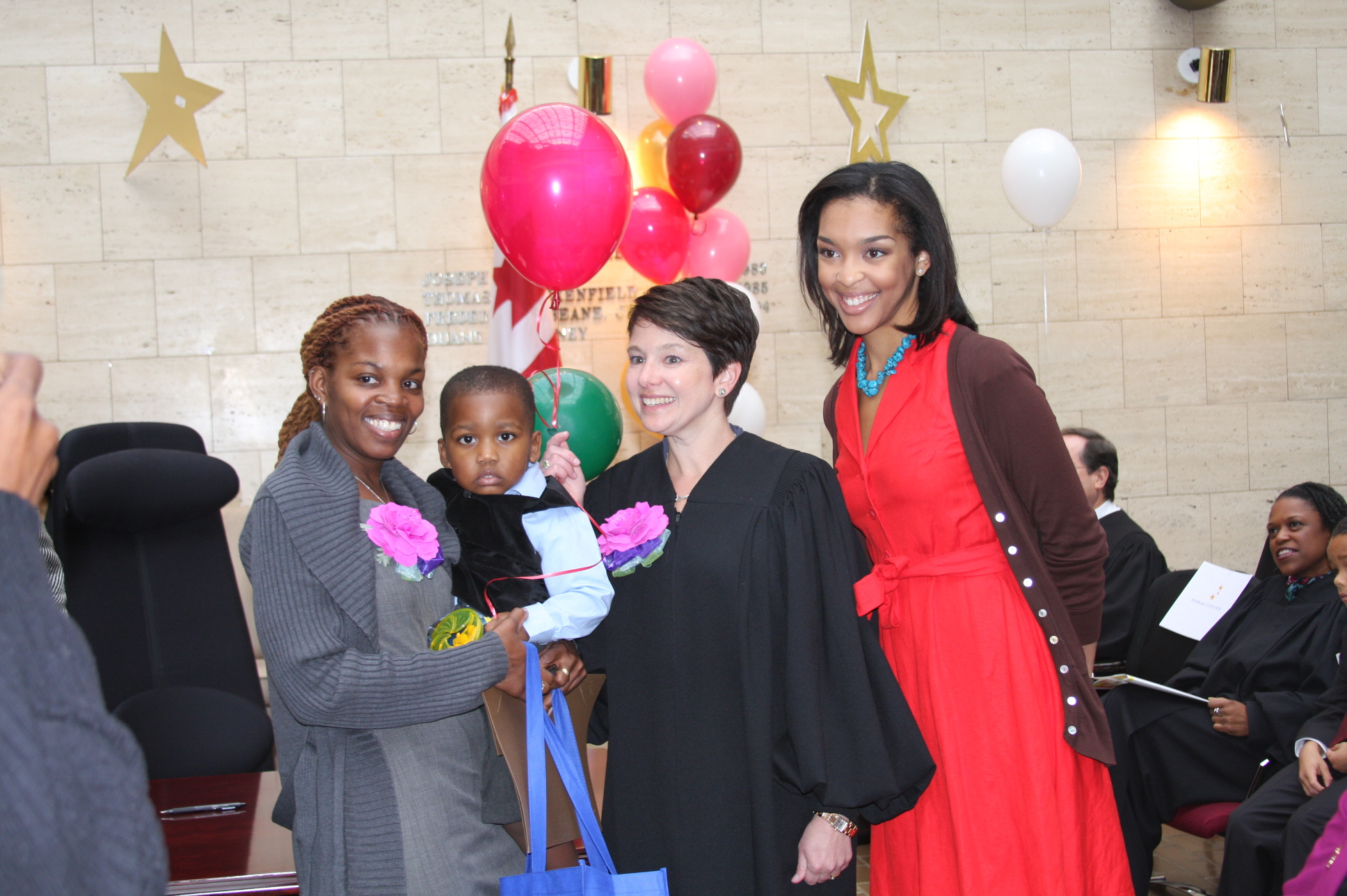
Washington, DC National Adoption Day Celebration, 2010
RISE AND SHINE
By Jim Barfield, (composed in support of National Adoption Day) copyright 2011
With the stroke of a pen,
A new family begins,
And it’s true beauty,
Will never end,
Rise and shine, rise and shine,
Sweet child of mine,
Rise and shine,
Rise above the things,
That pull you down,
And shine through the blindness,
That’s all around,
Rise and shine, rise and shine,
Sweet child of mine,
Rise and shine,
Rise above wrong turns in every road,
Shine your light straight from your soul,
Rise and shine, rise and shine,
Sweet child of mine,
Rise and shine,
(Bridge) I want you to know – I’m here to stay – I’m right beside you – each step of the way.
With open hands – and open heart – I will cherish each moment – doing my part,
(so you can) Rise and shine, rise and shine,
Sweet child of mine, rise and shine.


 Congressional Coalition on Adoption Institute