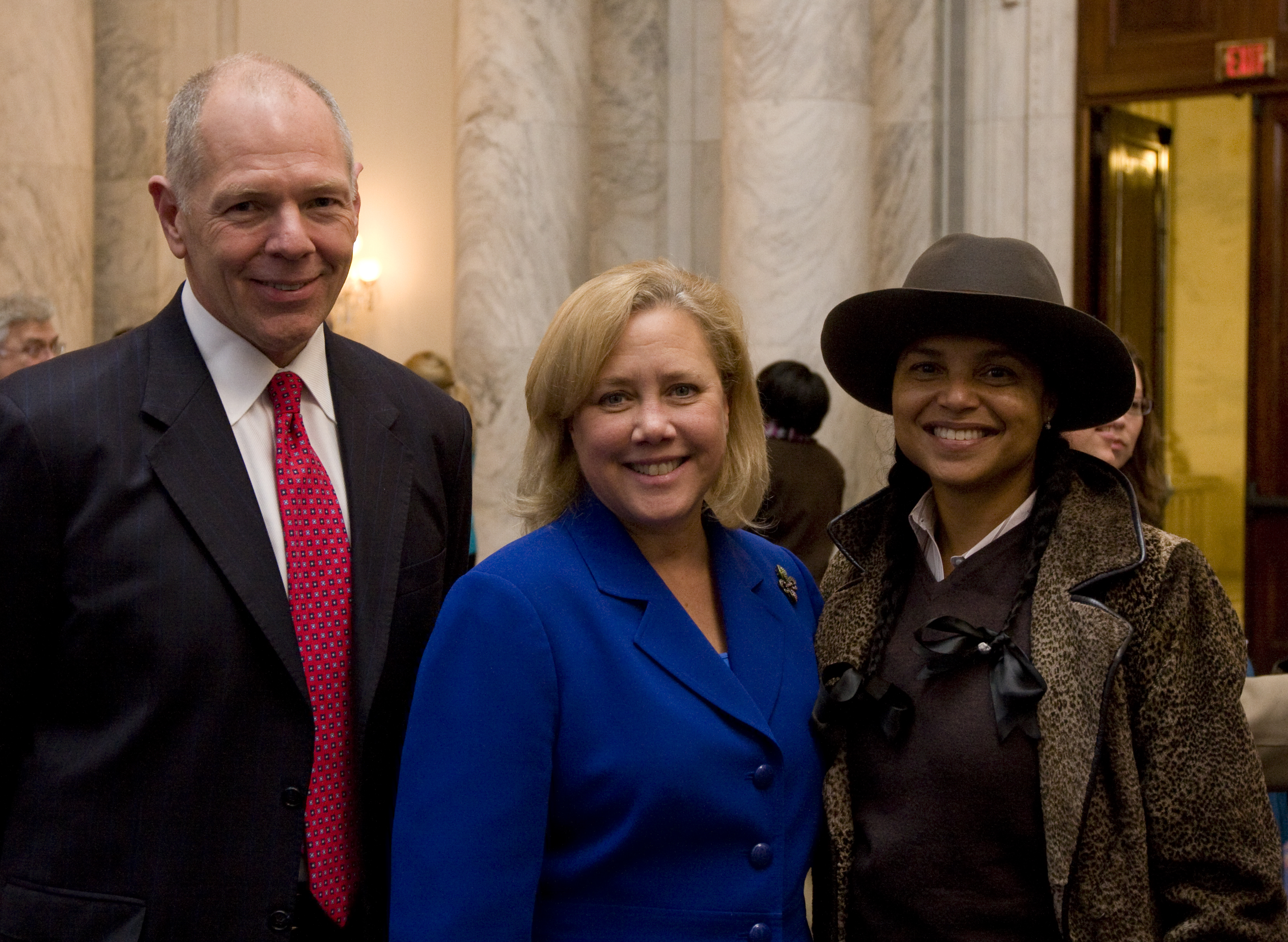
Leaders come together for the sake of orphans

Last week, CCAI hosted a reception to highlight the need for the world’s orphans to find forever families and to encourage leaders and advocates to continue their work on these issues.  This reception took place the evening before the National Prayer Breakfast and was attended by federal policymakers, business executives, and world leaders.  Sen. Mary Landrieu and Sen. James Inhofe, the Co-chairs of the Congressional Coalition on Adoption, spoke on behalf of Congress’ adoption caucus highlighting the need for legislation to be created that will promote the well-being of children in need of families.

Sen. Landrieu reminded us all that these orphans do not have people to speak on their behalf, rather, it is our duty to speak out for these children in need:

Sen. Inhofe shared how his adoptive granddaughter from Ethiopia has enlightened his work on adoption policy:

Pictures from the event:

Sens. Landrieu and Inhofe
CCAI Board Member Elmer Doty, Sen. Landrieu, Actor and Foster Care Advocate Victoria Rowell
CCAI Executive Director Kathleen Strottman


Sen. James Inhofe with attendees
Attendees

New intercountry adoption data released

In December, the U.S. Department of State released their FY 2010 Annual Report on Intercountry Adoptions.  The State Department first published this report for FY 2008 in response to a requirement put in place by the Intercountry Adoption Act of 2000.

The report shows that the total number for FY 2010 is 11,059 adoptions.  For the 6th year in a row, intercountry adoption has been on a steady decline.  Over the past decade, intercountry adoption saw a peak at 22,990 in FY 2004, however, the past two years we have seen numbers lower than they were in FY 1999.

Again this past year, China has been the top sending country at 3,401 total adoptions.  The second and third sending countries also remained unchanged from FY 2009 with Ethiopia at 2,513 total adoptions, and Russia at 1,082.

Photo from the U.S. Dept. of State website

To assist Americans in adopting internationally, the State Department has a list of Hague Accredited Adoption Providers, as well as country-specific information that explains the requirements and process of each country.

Streamlining in child welfare

Across the country, several states are working to make processes in child welfare and adoption more efficient.  Just last week in Pennsylvania, the state Supreme Court issued new rules meant to streamline the intercountry adoption process for PA residents.

The current intercountry adoption procedures that the U.S. Citizenship and Immigration Services and the U.S. Department of State operate under say that in order for a child’s adoption to be finalized abroad, both parents must be present in child’s country of origin.  This child would then enter the U.S. on an IR-3 or IH-3 visa and gain citizenship upon entering the U.S.  If only one parent is present, that parent receives custody for immigration purposes, however, the adoption will be legally finalized after entering the U.S., and the child is eligible for citizenship after the adoption is finalized here in the U.S.  In this scenario, the child immigrates with an IR-4 or IH-4 visa (the distinction is simply made depending on if the child’s country of origin is party to the Hague Convention on Intercountry Adoption).

In cases where only one parent is present, Pennsylvania courts have decided that parents are allowed to file a form petition and several required documents, instead of requiring a time-consuming process of duplicating paperwork from other government agencies.

Another example of child welfare-related processes being streamlined is in Iowa where child abuse and neglect complaints will now be directed to one centralized intake center, compared to their previous practice of having 99 separate counties accept reports.  The efficiency of this new process could prove vital in the state, which has a rate of reports at 59.6 per 1,000 children, compared to the national average of 43.1 per 1,000 children.

In Tennessee, a project was undertaken last year to improve the timeliness of foster care adoption.  The ultimate goal is to streamline the adoption process and move children into loving families  as soon as possible.  The idea grew out of a CCAI Advisory Board meeting conversation when Rep. Jim Cooper expressed concerns about inefficiencies in the child welfare system, and Elmer Doty, CCAI Executive Board Member, offered experts from his company to examine ways to improve the system.  Using Lean/Six Sigma tools and methodologies, experts from Vought Aircraft  (now owned by Triumph Group, Inc.) partnered with the Tennessee Department of Children’s Services to examine adoptions involving children who are in full guardianship with a family identified. What  resulted was a thorough, fact-based examination of the key processes of finalizing these adoptions, and finding ways to reduce the variance across regions.  Tennessee DCS officials began implementing recommendations last June and will begin tracking data over the next year.

The economics of adoption

An article came out earlier this week by Megan McArdle titled Abortion, Adoption, Supply and Demand that examined the link between adoption and abortion rates.  The author was arguing a claim made by a fellow writer, Andrew Sullivan, that promoting infant adoption is a feasible way to lower the abortion rate.  Sullivan wrote, “If the pro-life movement dedicated its every moment not to criminalizing abortion but to expanding adoption opportunities, it would win many more converts.”

McArdle responds, “I find it far-fetched that women are having abortions because no one is willing to help them give the baby up for adoption–there are lots of people and agencies that will not only help them, but pay a substantial portion of their expenses until they deliver.  They’re having abortions because pregnancy is physically uncomfortable, and there’s still a social stigma on women who carry a baby to term in order to give it away.”

Just a few months ago, the Center for American Progress released a report that seemingly aligns with McArdle’s viewpoint.  The report is titled The Adoption Option: Adoption Won’t Reduce Abortion but It Will Expand Women’s Choices.  In trying to educate readers about the abortion landscape, the report shared some statistics:

  • there are 6 million pregnancies in the U.S each year, almost half are unintended
  • 4 in 10 of all unintended pregnancies will end in abortion, roughly 1.2 million each year
  • 6 out of every 10 women who have abortions are already mothers
  • a mere 1% of all never-married women place their children for adoption

The report goes on to examine how prior to Roe v. Wade in 1973, the adoption rate was as high as 19.2% for white women, but fell to only 3.2% just fifteen years later.  The Guttmacher Institute writes that the decline in the adoption rate is affected by the societal shift in accepting single mothers, and that the abortion rate also fell during the same period time.  Because of this, the Institute points out that promoting adoption is not an effective strategy for reducing the abortion rate.

A few of the policy recommendations the report includes is that more research is required to best serve the needs of women considering adoption, along with greater awareness about the modern adoption system, and improved post-adoption services.

Adoption! adoption! read all about it

This week, several news stories about adoption have appeared, from new celebrities showing an interest in adoption to a couple using a billboard to express their interest in becoming adoptive parents.  From North Carolina courts voiding an adoption by one of their lesbian state senators to a new Michigan law ensuring relatives are given special consideration when placing children who are in foster care.

While I could spend time commenting on any one of these unique stories, it’s this video that I’d rather draw your attention to:

This video was shared by Forever Family, whose founder Gia Tutalo-Mote was a 2009 Angel in Adoption.

It serves as a simple reminder that until each child has just that, a forever family, our work is not done.  Thank you all for your partnership and support of this past year.  We’re looking forward to continuing to be a voice for the world’s orphans in 2011, and hopefully celebrating new victories in our fight to ensure each child has a loving home and bright future.


This year, a home for the holidays

Be sure to tune into A Home For the Holidays which will air tonight on CBS.  This is the 12th annual special meant to raise awareness about foster care adoption.  This year will feature performances by Katy Perry, Maroon 5, Ricky Martin, Nelly, Melissa Etheridge, and 2010 Angels in Adoption gala performer, Jimmy Wayne.

I got to thinking about what this time of year means to children who were once bounced around in foster home, never belonging to a family or knowing the love of a parent.  I wanted to hear firsthand what it means for a former foster child to finally have ‘a home for the holidays’.  I reached out to one of CCAI’s 2010 Foster Youth Interns and asked him just that.  Here is what he said:

I’ll be home for Chri…wait, will I? That is a question that so many children and youth in foster care wonder when this time of year comes around. All too often, people get lost in what the meaning of the holidays really is, and too easily take for granted spending the holidays with loved ones.  There are children in foster care who will be spending Christmas in a new foster home apart from siblings and any family they’ve ever known.

I was very fortunate to have been placed in a foster home with a lady who quickly grew to love, cherish, and treat me no differently than if I was her own child.  The love and stability and comfort I lacked growing up I found in this home.  Because of this, family is something that has been and will always be important to me.  But when I turn on the news and find out a foster youth took his own life out of loneliness and hopelessness the day after thanksgiving, I can’t help but think how we must be willing and commit to doing more for this country’s foster youth.

I think we all, no matter if you work in child welfare or not, need to look around at the people in our lives who may not have everything needed to enjoy the holidays.  We can all play a part in making the holidays a special time for everyone.  Just being able to turn to someone on Christmas morning and say exactly that, “Merry Christmas” is, in every sense of the word, the most meaningful gift.

Now here is what I want you to do.  I want you to go through your phone book and find a friend or a family member who you may of not talked to in a while, dial their number, and just talk to them. Say “Happy Holidays” and just listen to them.  Again, having the ability to talk to someone or possessing the feeling that someone really cares about you and loves you really brings back the true meanings of what the holidays are about.

As you enter 2011, think about what you can do for a child in foster care in your community to make sure this time next year, they have that person who loves and cares about them.

Happy Holidays, everyone!”

-Jeremy Long, 2010 FYI

CCAI wishes you all a safe and joyous holiday!