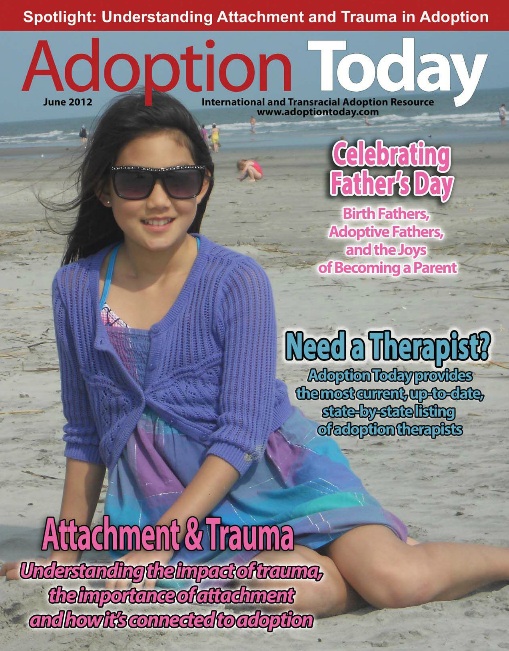
Adoption Today Features Article on Angels in Adoption™

Nominate an Angel in Adoption™!

By Kathleen Strottman and Allison Cappa

“Each time a man stands up for an ideal, or acts to improve the lot of others, or strikes out against injustice, he sends forth a tiny ripple of hope.” Robert F. Kennedy said so eloquently what we at the Congressional Coalition on Adoption Institute (CCAI) try to uphold daily and who we hope to esteem through our Angels in Adoption™ Program.

The Program began 14 years ago when a few Congressional offices began to brainstorm about the good that could come from honoring deserving constituents from their state and/or district who had impacted the life of a child in need of a loving family. That first year, in 1999, an awards ceremony was held on Capitol Hill to celebrate those very constituents. As co-founding Member of the Congressional Coalition on Adoption caucus and adoptive father Rep. Jim Oberstar puts it, “the first event was sparkling. There was so much enthusiasm and love.”

Since that time, Angels in Adoption™ has grown to be three days of events with over 1800 individuals, couples, and organizations recognized for the incredible work they have done to highlight the issue of foster care and adoption.  The Angels are invited to travel to Washington, D.C., where they learn how to advocate on behalf of children around the world waiting for a loving family to call their own. Additionally, they are honored at a prestigious Congressional Pinning Ceremony and at a very special Gala attended by senior members of the Executive Branch, US Senators, US Representatives and National Angels, like Kristin Chenoweth, First Lady Laura Bush, Patti LaBelle and Al Roker, who are using their celebrity status to promote adoption on a national and even global level. Furthermore, Angels in Adoption™ seeks to increase the public awareness of these individual deeds that profoundly impact a child’s life. The press from this event has spurred hundreds of human interest stories with the hope of inspiring others. Since the program’s inception, more than 1,800 Angels have been honored for their contributions to the cause of finding every child a home.

We all know the miraculous effect adoption has.  Because of Angels in Adoption that message is spreading. As 2011 National Angel in Adoption™, award winning actress (star of “My Big Fat Greek Wedding”), former National Adoption Day spokesperson, Nia Vardalos, said of the adoption of her daughter, “My husband and I were matched with our daughter via American Foster Care, and the minute we met her, our lives changed forever.  At three years old, our perfect little girl walked into our house, and turned it into a home.”

Do you know of someone you would like to nominate to a Congressional Office because adoption or fostering children has changed their life forever? Nominate them as an Angel in Adoption™ by visiting www.angelsinadoption.org. You can also complete a nomination form online for submission which will be passed along to an appropriate Congressional office. The deadline for this year’s nomination is July 6, 2012. 

The preceding article was featured on page eight of the June 2012 Issue of Adoption Today. See Adoption Today.

The high societal and financial costs of over medicating our nation’s foster youth

Yesterday, the Senate Committee on Homeland Security and Government Affairs held a hearing on the high societal and financial costs of over medicating our nation’s foster youth.    CCAI would like to commend Chairman Thomas Carper and Ranking Member Scott Brown for their leadership in addressing such an important issue.  While the findings of the GAO are shocking to say the least, it is sadly not surprising to learn that youth in our Nation’s foster care are being victimized in this way.  We not only can, but we must, do better.  Issues such as the overuse of psychotropic drugs and the lack of quality mental health care are ones that have come up time and time again in the past four years of Foster Youth Intern Reports.  These wise young leaders have identified several factors which contribute to the disturbing trends revealed by yesterday’s hearing.

First, it is important to bear in mind how the federal government currently finances the foster care system.  Under the law today, states on average receive a high level of reimbursement for a child who has special needs and for children who are in congregate care.  The rationale behind such policies is that it stands to reason that the care of such children would in fact be higher than a child without special needs or who could be cared for in an individual family.  Yet, without proper screening methods and controls, it is quite possible for states to improperly label children so that they can receive the highest level of funds available for the care of a child.  This is not to suggest that states are purposely lying about the needs kids have, but there is evidence to suggest that financing and budget decisions are playing a role in the care decisions being made on their behalf.

Secondly, many CCAI Foster Youth Interns (FYIs) report that their experience in receiving mental health services while in foster care was suboptimal.  They are right to point out that the professionals (doctors, therapists, etc.) they are in the care of are often new to the profession and least likely to be trained in state of the art treatments specific to the needs of youth in care.  This is due in part to the fact that they are most often receiving these services through Medicaid.  So in essence, these kids, who are acknowledged by all to have some of the most complex mental health issues to grapple with, are being treated by those least likely to have the training and skills necessary to treat them.

Thirdly, the fact remains that there is only one foster family for every four children who need foster care.  What this means is that children in foster care are being cared for in group homes and by foster families that are often stretched to the brink.  In these settings, the use of mind altering medication can become a way to “keep control” of kids behavior.  Year in and year out, FYIs have called on the federal government to increase its efforts to promote the recruitment and training of foster parents so that each and every child can have a family to give them the love and support they need to help them heal.

And finally, as the stories of the two children profiled by Diane Sawyer yet again prove the best medicine we can give these children is the family that they need and deserve.  As Keonte said yesterday, it was his adoptive parents who made him feel safe and loved enough to sort through the issues he faced because of his past.  It was his adoptive parents who sought out the top of the line treatment that has helped him heal.  And it was his adoptive parents who sat by his side as he stood before the US Congress to demand that this no longer be the case for other children.

Keonte testifying in Congress. Photo credit: ABC News from http://abcnews.go.com/blogs/headlines/2011/12/boy-12-tells-congress-of-years-on-stupid-meds/


Catch ABC’s 20/20 special tonight continuing the story on this topic.

Celebrate National Adoption Month

Today is the first day of National Adoption Month.  Throughout the month, policymakers, social workers, adoption advocates, and families will be coming together to raise awareness about the 107,000 children in foster care waiting to be adopted.  The Administration for Children and Families has a portion of their site devoted to information about National Adoption Month.

In a few short weeks, nearly 400 communities across the country will be hosting events on Saturday, November 19th in celebration of National Adoption Day.  These events are not only a special occasion for nearly 5,000 children that will be adopted during these events, but also is a way the community can come out to support families and learn about how to get involved in the life of a child in foster care.

These children need your help.  They are at risk for languishing in foster care for years not knowing the love and security of a family and never having their full potential realized because no one is encouraging or supporting them.

Please consider promoting National Adoption Day (NAD) in the following ways:

  • Encourage Elected Government Officials to support NAD.  Reach out to officials on the local, state, and federal level to encourage them to attend an event, issue a press release, write an op ed, issue a proclamation, or blog or tweet about NAD.  Call their office or send an email referring them to visit www.ccainstitute.org/nad for resources.
  • Engage the Media and Local Business.  Reach out to your local event planner and ask them if they need help inviting the local media, asking businesses to donate goods to the event, or ask faith-based organizations to promote this event.
  • Write, Blog, Facebook, or Tweet about NAD.  Encourage others in your community to get involved, and be sure to link to @natadoptionday and use the hashtag #nationaladoptionday.
  • Impact the Life of a Child.  Reach out to local government and non-profit agencies in your area to get more information about how to mentor a child, become a Court Appointed Special Advocate, provide respite care for children, become a foster parent, or adopt a child in need of a family.  Click here for more information.

Foster care adoption recruitment model proves success

This week, the Dave Thomas Foundation for Adoption (DTFA) released findings from a five year study led by Child Trends that shows their child-focused Wendy’s Wonderful Kids (WWK) recruitment model is successful.  The study found that there is up to a three-fold increase in adoptions among youth in foster care when using this model.  Read the full press release to learn more about the study and findings.

The research shows that:

  • Children in foster care served by WWK recruiters are more than 1.7 times more likely to be adopted than those not served by WWK.
  • For older children, the impact of the WWK model is greater and increases with age:  For children referred to WWK at age 8, the likelihood of adoption was one-and-one-half times higher; For children referred at age 11, the likelihood was two times higher; and For children referred at age 15, the likelihood of adoption was three times higher.
  • Children with mental health disorders served by WWK are three times more likely to find forever families than those not served by WWK.

“Multiple research studies have found that adoption represents a cost savings to taxpayers, with one indicating that each dollar spent on the adoption of a child from U.S. foster care yields three dollars in benefits to society, demonstrating that investment in adoption not only benefits the child, but society as well,” the press release by DTFA states.

Read the research findings, executive summary, and access the fact sheet here: http://www.davethomasfoundation.org/read-the-research/


TV star Willie Garson premiers adoption PSA

In an interview with Willie Garson, actor and star of USA Network’s White Collar, Garson talks about his character, Mozzie, who the show revealed last night was in foster care as a child.  Garson used this opportunity to talk about his son Nathen who he adopted from California’s foster care system.  The interview focuses on his experience adopting and the adjustment period.  Garson talks about using his celebrity to bring awareness to this issue and correct misconceptions in hopes of finding loving families for children in foster care.

“You know there’s a lot of kids out there, especially, I think, more so in this economy, there’s a lot of kids out there that for some reason that their parents are not able to take care of them, and there’s people who can take care of them, and they should be aware of that. […]  There’s nothing more satisfying then sharing a life with a child, nothing more satisfying. I get much more out of it than anything I give out.”