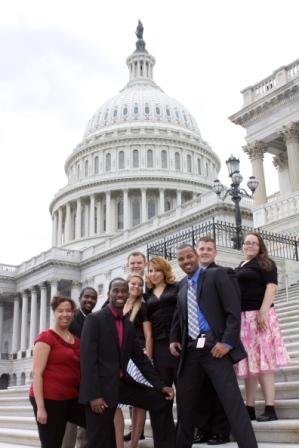
CCAI is extremely excited that our 15 Foster Youth Interns (FYI) arrive in Washington, DC today to begin their summer-long assignment on Capitol Hill.
This assignment provides individuals who have spent time in the United States foster care system with an opportunity to intern in a Congressional office, and share their experiences, opinions and unique perspectives with policymakers in Congress. This year marks the 10th anniversary of the program; 106 extremely talented, passionate and impressive individuals have participated in the past decade.
Welcome to Washington, FYIs. We’ve been waiting for you!
FYI Class of 2009FYI Class of 2010FYI Class of 2011FYI Class of 2012
January 6th is the deadline to submit applications for the 2012 CCAI Foster Youth Internship Program. This program brings current and former foster youth from across the country to intern in Congressional offices for a summer internship. During the program, interns participate in a number of advocacy and professional development activities. They have the opportunity to share their firsthand knowledge of the strengths and weaknesses of foster care with policymakers who can affect change.
See how these former interns were impacted by the program:
“I recommended the FYI program to a friend of mine who ultimately interned through FYI the year after I did. Like me, he has also stated that he felt this was a life changing opportunity for him. I continue to encourage foster care alumni who I know to apply for this program because I feel that this is a wonderful opportunity to see our nation’s capitol, to learn about the political structure of our legislature and to meet other people who have similar life experiences to themselves.”
“Due to being an intern with FYI, CCAI asked me to help them pick interns for a couple of the other classes, which was an honor but a grueling decision to have to make. CCAI also contacts me every Christmas to send me cards and gifts, which makes me feel like they are remembering me and caring about my future. I have also nominated a number of people I know for Angels in Adoption and their selection has been one of the few ways I have felt that I have been able to thank them in the way that they truly deserve. Thanking these people has been a delight for me and for the people who were recognized and I feel that the legislators who made the choices were more educated for having learned about them.”
“The FYI program was where I discovered what I actually wanted to do; how I wanted to impact the foster care system. For nearly three years I had been passionate about reforming the foster care system, but it was during my time on the Hill that I realized how I wanted to change it. While direct service was rewarding to me, I felt like I wasn’t able to change the foster care system on a substantive level. The FYI program didn’t just teach me legislative ideas, it inspired me and emboldened me to create my own ideas.”
Yesterday, the Senate Committee on Homeland Security and Government Affairs held a hearing on the high societal and financial costs of over medicating our nation’s foster youth. CCAI would like to commend Chairman Thomas Carper and Ranking Member Scott Brown for their leadership in addressing such an important issue. While the findings of the GAO are shocking to say the least, it is sadly not surprising to learn that youth in our Nation’s foster care are being victimized in this way. We not only can, but we must, do better. Issues such as the overuse of psychotropic drugs and the lack of quality mental health care are ones that have come up time and time again in the past four years of Foster Youth Intern Reports. These wise young leaders have identified several factors which contribute to the disturbing trends revealed by yesterday’s hearing.
First, it is important to bear in mind how the federal government currently finances the foster care system. Under the law today, states on average receive a high level of reimbursement for a child who has special needs and for children who are in congregate care. The rationale behind such policies is that it stands to reason that the care of such children would in fact be higher than a child without special needs or who could be cared for in an individual family. Yet, without proper screening methods and controls, it is quite possible for states to improperly label children so that they can receive the highest level of funds available for the care of a child. This is not to suggest that states are purposely lying about the needs kids have, but there is evidence to suggest that financing and budget decisions are playing a role in the care decisions being made on their behalf.
Secondly, many CCAI Foster Youth Interns (FYIs) report that their experience in receiving mental health services while in foster care was suboptimal. They are right to point out that the professionals (doctors, therapists, etc.) they are in the care of are often new to the profession and least likely to be trained in state of the art treatments specific to the needs of youth in care. This is due in part to the fact that they are most often receiving these services through Medicaid. So in essence, these kids, who are acknowledged by all to have some of the most complex mental health issues to grapple with, are being treated by those least likely to have the training and skills necessary to treat them.
Thirdly, the fact remains that there is only one foster family for every four children who need foster care. What this means is that children in foster care are being cared for in group homes and by foster families that are often stretched to the brink. In these settings, the use of mind altering medication can become a way to “keep control” of kids behavior. Year in and year out, FYIs have called on the federal government to increase its efforts to promote the recruitment and training of foster parents so that each and every child can have a family to give them the love and support they need to help them heal.
And finally, as the stories of the two children profiled by Diane Sawyer yet again prove the best medicine we can give these children is the family that they need and deserve. As Keonte said yesterday, it was his adoptive parents who made him feel safe and loved enough to sort through the issues he faced because of his past. It was his adoptive parents who sought out the top of the line treatment that has helped him heal. And it was his adoptive parents who sat by his side as he stood before the US Congress to demand that this no longer be the case for other children.
An Associated Press article from August 16 discusses Rep. James Langevin’s work on legislation that would help protect youth in foster care from identity theft and credit fraud by requiring states to run credit checks on foster children and assist those who become victims of identity theft as well as prohibiting states from putting Social Security numbers in foster care records as a means of child identification.
The article first discusses how foster youth in care and aging out of care are already financially disadvantaged compared to their non-foster youth peers. Complicating this reality for foster youth is the fact that, unknown to them, many are victims of identity theft or other financial crimes. One study from California estimates that up to 50 percent of the children in the state’s system have been victims of identity theft. Of great concern to many child welfare experts is how unknown and widespread this problem is across the country.
The financial security of current and former foster youth is a growing issue of concern among those in the field. Earlier this year, the Children’s Advocacy Institute and First Star hosted a Congressional briefing to mark the release of the report, The Fleecing of Foster Children: How We Confiscate Their Assets and Undermine Their Financial Security. The report addresses various aspects of youth’s financial well-being in care, including topics such as protection from social security fraud and promoting Individual Development Accounts.
One of CCAI’s 2010 Foster Youth Interns, Jeremy Long, was featured in a news clip about Colorado state legislation also targeted toward protecting foster youth from identity theft. Shortly after seeing this story, one child welfare practitioner from Florida contacted CCAI and commented, “Families that adopt our foster children and foster children themselves encounter a serious problem. More times than not parents whose parental rights have been terminated continue to use their child’s social security number to commit fraud such as for welfare funds, food stamps or income tax deductions.







 Congressional Coalition on Adoption Institute