CCAI’s Commitment to Rebuilding Haiti

On May 9th, 2010, almost five months after the earthquake, the AP published an article entitled “Desperate Parents Abandon Children in Haiti.”  In it, they described how poor parents, who had been struggling to provide for their children before the disaster, have been all but pushed over the edge by its effects.  It also describes how many of these parents have come to look to orphanages and IDP camps as places where they might receive the help they are most desperately in need of.  I was struck by one part in particular which read,

The United Nation’s Children’s Fund set up a toll-free hotline in February for abandoned or lost children who had been separated from their families during the quake. The call center has registered 960 children so far. ”We don’t call them orphans because they could have family,” explained Edward Carwardine, UNICEF’s spokesman in Haiti.

UNICEF gave the hot line number only to agencies and aid workers — not the public — for fear of an avalanche of calls from desperate families trying to unload their children.

To me, these four sentences say a lot about what is wrong with our current approach to serving  not only Haiti’s, but also the world’s orphans.  First, as always, we seem to spend more time talking about whether the children of desperately poor parents are orphans than we do in trying to prevent these parents from being in circumstances that at some point down the road will make them orphans.  Secondly, we incorrectly view the work that is going on in Haiti today as “disaster relief and response” when in truth the problems facing children in Haiti existed long before the earthquake and unless something is changed, will exist long after disaster relief has moved elsewhere.  Finally, we have yet to realize that instead of establishing a hotline number for the relatively small number of families who have been unwittingly separated from their children because of the quake, the U.S. government, the Haitian government, and its Donor and Non-Governmental partners, should be working to set up safety nets to support “the avalanche of calls from desperate families trying to unload their children.”

At CCAI, we believe that the international paradigm around serving orphan and vulnerable children must change.  Instead of spending hundreds of millions of dollars on caring for children because have been orphaned we need to invest millions of dollars in practice proven strategies to prevent them from being orphans.  How to do this is simple.  We must invest more in a keeping families intact and when that proves impossible, we must invest in systems to place children into other permanent family settings through kinship care, guardianship, domestic and international adoption.

To that end, CCAI recently hosted over 50 U.S. and international experts in providing permanency to children.  We asked them to collectively consider what could be done to change the system of child welfare in Haiti from one that relied heavily on institutions and international adoption to one in which depends of the fuller continuum of child welfare services described above.  I personally took away three things from this meeting.  First, the majority of the children who are abandoned to institutions in Haiti are abandoned because of poverty.  Parents (which in many cases are single mothers) place children in orphanages or worse allow them to be used as restaveks in the hope that these new homes will give them what they cannot: food, shelter, health care and an education.   It is not enough to put in place employment, housing, health care and education programs and hope that the presence of these things will assist these families.  As we do here in the United States (  i.e. TANF, SCHIP, public education, section 8   ) we must take special effort to ensure that dedicated programs exist to provide these four things specifically to children and families.

I also learned that in our desire to help, we can be part of the problem.  Haiti already had the highest rate of NGOs per capita before the storm and some reports say that the number has doubled since the disaster.  Oftentimes, well meaning organizations are providing services without the knowledge or consent of the Haitian government or which are duplicative, counterproductive or non-coordinated with other similar N.G.Os.    This situation not only makes the Haitian government appear powerless, but most likely results in a great deal of time and money being wasted.  At least in the area of child welfare, we need to shift this paradigm away from the status quo toward one in which the Haitian government is the lead and NGOs are called upon to fill needs the government wants, but cannot provide.
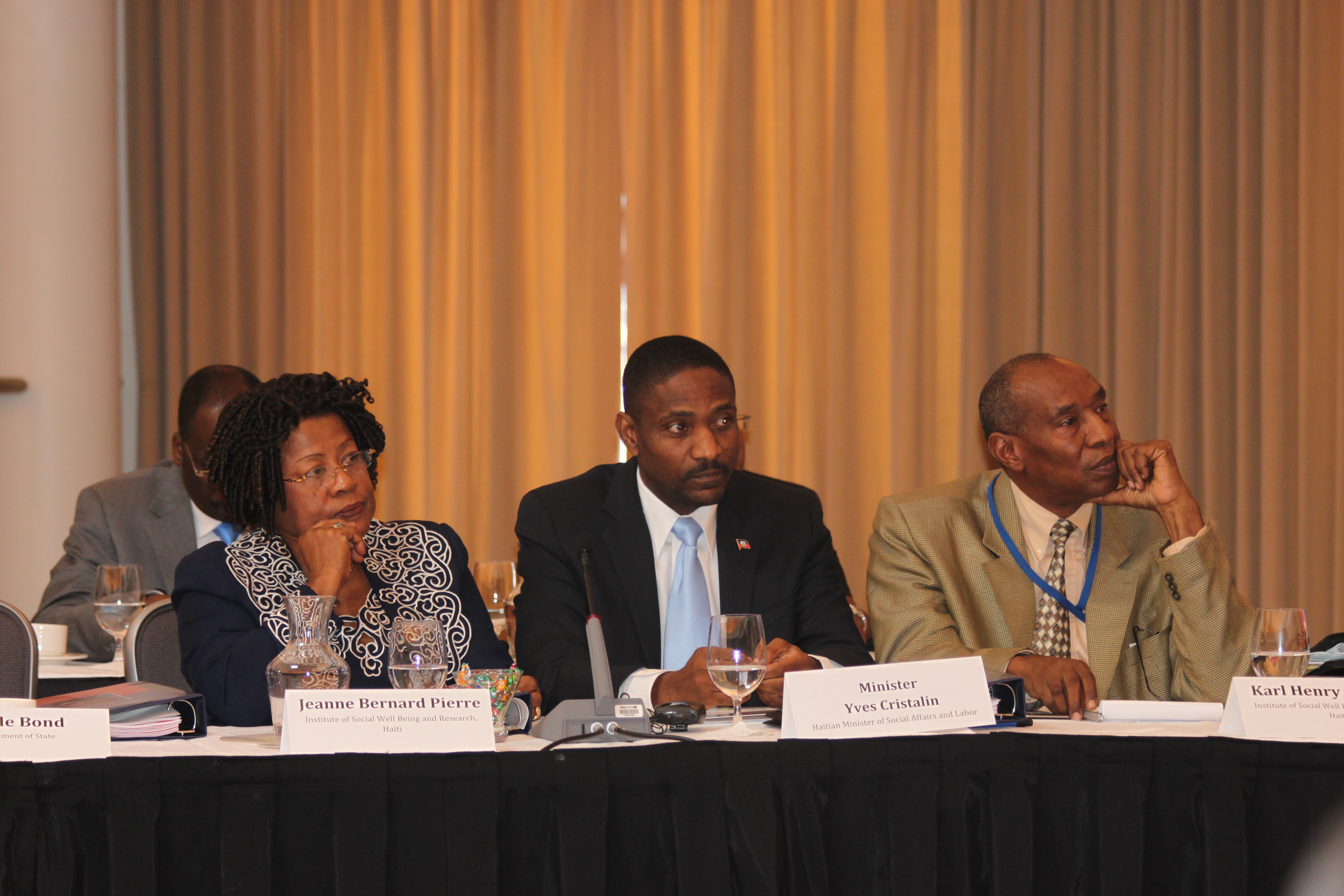
Finally,  this meeting emboldened me in the belief that one of the most precious forms of assistance we can provide the Haitian people moving forward is the value of our experience.  I know that several of our Nation’s top experts in education reform have already been called upon to help in establishing Haiti’s first ever publicly funded education system.  Lessons from the transformation of urban school systems, such a New Orleans, are being used as prototypes to base this type of reform in Haiti.  For the past 50 years, some of the best minds have been dedicated to ensuring the children in America have access to safe and stable families who can provide them with all they require to grow into healthy, productive future citizens.  We should use this to help the Haitian officials learn from our success and avoid our failures.

The convening was just a first step.  And CCAI remains committed to helping the Government of Haiti in establishing a child welfare system that serves children in and through families.  Looking forward realizing that day with all of you.

Returnable child?

13,231.  That is the number of Russian children who have found permanent, loving homes in America over the last five years.  One.  That is the number of adoptive parents who made the irresponsible, dare I say reprehensible, decision to return her adopted child to Russia.  800,000.  That is the estimated number of Russian children who currently call an orphanage their home.  As we talk about the circumstances leading up to the possible suspension of Russian-American adoptions, it is important to keep these numbers in their proper perspective.  No one can condone the actions taken by Torry Hansen.  Even if her allegations about her son’s mental condition are true, they do not justify her decision to forgo the plethora of options of assistance available for she and her son in the United States.  She could have reached out to her adoption agency, who could have directly provided her and her son the necessary support.  She could have reached out to the State of Tennessee Departments of Social Services or Mental Health.  And in a State that is well known for extensive faith based and community based networks there were undoubtedly people who if asked, would have stepped forward to help this family in need.  Sadly, she chose to take a different route and it is now in the hands of the Tennessee legal authorities to determine if her actions constitute a crime.

All that being said, two things we know for sure.  First, suspensions of adoption are not in the overall best interests of children.  Experience has shown that suspending adoptions do not lead to the legal and programmatic reforms which are used to justify them.  What they do result in is children spending additional, and unnecessary years, in institutional care.  Take Romania and Cambodia for examples.  It has been almost ten years since both countries suspended international adoption.  No significant legal reforms have been made and few, if any, efforts have been made to provide children living there with alternatives to institutionalization.  The legal and social status of children in both countries remain the same.  Both countries still experience high rates of child abandonment, child slavery and sexual exploitation.

The other thing we know for sure is that despite the appropriate use of best practices and protections, there will be cases such as these.  Not even the perfect system can protect against all wrongdoing.  What needs to exist is an international adoption system which provides for a high level of protection against corruption and abuse, and a federal and state statutes that allow for the prosecution of individuals who, despite these protections, abuse the adoption process or worse, an adopted child.  In ratifying the Hague Treaty on Intercountry Adoption, the US took an important first step in providing the U.S framework for such a system.  CCAI, along with Members of Congress, continue to push for improvements to the intercountry adoption system and for stronger and more explicit laws against corruption in international adoption.  We have and will continue to fully support the Russian Government in their efforts to continually protect the best interests of their children.  And finally, we remain committed to work with the U.S. State Department toward developing ways to quickly implement necessary protections.

In the meanwhile, as those who have experienced the many joys adoption brings, we have an obligation to speak out against the myths these types of cases can perpetuate.  Older children, even those who have spent years in foster care or institutions, are not by definition, damaged goods.  The bond between an adoptive parent and child is, in most every case, indistinguishable from the bond between a parent and their biological child.  And regardless of how the relationship between parent and child is formed, being a parent is one of the most challenging, yet rewarding, experiences a human being can have.

Be sure to check our website for resources as new information becomes available.

Op-Ed on Haiti’s Orphans from CCAI’S Executive Director

Orphan Children of Haiti Deserve a Future

Since last week’s devastating earthquake, the Congressional Coalition on Adoption Institute (CCAI) has been engaged in helping Members of Congress in developing an appropriate response to the immediate and long term needs of Haiti’s orphaned children.   Within hours of this tragedy, Congressional offices were flooded with offers of help for orphans and requests for media interviews on this subject have been unending. As I watch all of this unfold, I find myself with mixed emotions.  On one hand, I am happy to see the world so keenly focused on the needs of orphan children.   On the other, I am perplexed as to why it has to take a natural disaster for the world to focus on a problem that has existed for some time.  As has been reported, there were 380,000 orphans in Haiti when the earthquake occurred (UNICEF, 2007).   To put that into perspective, that is a population higher than that of Pittsburgh.  A small portion of these children found refuge in the country’s 184 licensed orphanages, while the vast majority was condemned to a life on the streets.  How they were orphaned is also no mystery.  Like in so many other places, it was poverty, war, disease and cultural norms, which forced their families to abandon them.   And these conditions are only going to be made worse by recent events.

When Katrina hit the Gulf Coast nearly five years ago, our country learned many lessons.  One thing we learned was that after a disaster of this magnitude you can do one of two things.  You can spend your time and resources to rebuild a place to be the same as it was before or you can use the opportunity to begin anew.  Take for example the public education system in New Orleans.   In the five years since the storm, Louisiana leaders have used the combination of an unprecedented level of national investment, innovative best practices, and reform minded leadership to put New Orleans public schools on track to become the best in our Nation.

As a global community, we have the same choice here.  We can go about making plans to provide protection to orphan children in temporary shelters until they can be returned to their orphanages, or worse the streets, or we can take the recent outpouring of international support and use it to begin anew.  Working together, we can help the people of Haiti to develop a child welfare system in which Haitian children are being raised in safe, loving and permanent families, not by institutions.  Such a system could be built upon international best practices in preserving families, providing foster care, as well as promoting domestic and international adoption.

Surely, plans to rebuild the physical infrastructure of Haiti will not call for rebuilding the concrete on concrete buildings that all but folded from the quake.  No doubt, they will call for the buildings to be rebuilt using the latest earthquake-proof technology.  The orphans of Haiti need and deserve this same forward thinking approach. Let us not make the mistake of thinking that the only structures that need our help in rebuilding are physical.

Kathleen Strottman is the Executive Director of the Congressional Coalition on Adoption Institute(CCAI), nonprofit, nonpartisan organization dedicated to raising awareness about the millions of children around the world in need of permanent, safe, and loving homes and to eliminating the barriers that hinder these children from realizing their basic right of a family. Kathleen comes to this role after serving nearly 8 years on staff for Senator Mary Landrieu (D-LA)