Update on Russian Ban on Intercountry Adoptions to the United States


russia_flag

Following the January 22, 2013 Russian Supreme Court Letter on Implementation of Federal Law No. 272-FZ, CCAI has continued to work closely with Members of Congress and our partners inside Russia.  In situations like these, CCAI’s priority is to ensure that the U.S. government is aware of all individuals directly impacted and have the information necessary to act on their behalf.  The following are actions that have occurred since our last update:

House Resolution 24: Expressing the deep disappointment of the House of Representatives in the enactment by the Russia Government of a law ending inter-country adoptions of Russian children by United States citizens…

  • Introduced on January 14, 2013 by Congressional Coalition on Adoption Co-Chairs Representatives Michele Bachmann and Karen Bass.
  • House Resolution 24 language matches that of Senate Resolution 628 (introduced in the 112th Congress on Dec. 30, 2012).

January 17, 2013 House Letter to President Putin  

  • Led by Representatives Chris Smith and Michael Fitzpatrick, 46 U.S. Representatives signed a letter to President Putin appealing to him for humanitarian reasons to not apply the January 1, 2013 ban of adoptions of Russian children to the United States to those several hundred adoptions already in process when the ban was enacted.
  • Noted that many of the children who are impacted by the ban on adoptions already know their U.S. adoptive families and have even recently been visited by them.
  • Encouraged President Putin to work together with the U.S. to “ensure that children are moved from institutions to family care.”

January 18, 2013 Bicameral Letter to President Putin

  • Led by Senator Blunt and CCA Co-Chairs Senators Landrieu and Inhofe and Representatives Bachmann and Bass, 72 Members of Congress signed this letter to President Putin requesting that the Russian Federation allow the processing of the pending adoptions of children already matched in 2012 to U.S. families.
  • Noted that many of these children have special needs, and “many believed they were soon going to become a part of a safe, permanent and loving family.”
  • Appealed to the spirit of the bilateral adoption agreement the two countries entered into on November 1, 2012 to provide orphaned children with safe and loving homes.

January 18, 2013 Bicameral Letter to President Obama

  • Led by Senator Blunt and CCA Co-Chairs Senators Landrieu and Inhofe and Representatives Bachmann and Bass, 73 Members of Congress signed this letter to President Obama.
  • Noted that Russia’s Ministry of Science and Education estimates over 110,000 children in Russia are living in institutions, with only 7,400 adopted by Russian families annually.
  • Appealed to President Obama to work to reverse the ban, but also to prioritize in the United States’ discussions with Russia in the coming weeks the estimated 350-500 active adoption cases with Russian children.

January 14, 2013 Russian Response Letter to December 21, 2012 Congressional Letter to President Putin

  • On January 14, Ambassador-at-Large Konstantin Dolgov – Russian Foreign Ministry’s Special Representative on Human Rights, Democracy and the Rule of Law – responded to a December 21, 2012 letter from 16 Members of Congress in an immediate response to the news of what was then a potential ban of adoptions from Russia to the United States.
  • Ambassador Dolgov’s letter stated that “[a]ccusations that Russia has violated the [U.N. Convention on the Rights of the Child] by adopting the Dima Yakovlev Law are absolutely ungrounded” and are instead aimed at prioritizing domestic adoptions in Russia.  Suggesting that abuse of Russian children by American families has regularly occurred recently, and “the openly inactive attitude of competent U.S. agencies towards these issues has provoked a particular indignation and incomprehension in the public opinion, political and parliamentary circles in Russia.”  In response to appeals to the November 1, 2012 bilateral adoption agreement between the two countries, the letter states, “in practice we see that the U.S. side is actually sabotaging the provisions of the document.”  “The decision taken by the Federal Assembly of the Russian Federation to ban the adoption of Russian children to the U.S. was a difficult but necessary measure provoked by a consistently non-constructive position of the U.S. federal and local authorities.”

For more information, please visit CCAI’s Russia Page on our website, see the “Russia Bans Adoptions to the United States” section of our January 15, 2013 Legislative Update,

CCAI Legislative and Policy Update – January 2013

In this Update:

  • Adoption Tax Credit Extended in Tax Payer Relief Act
  • Russia Bans Adoptions to the United States
  • Universal Accreditation for Intercountry Adoptions in the U.S.
  • Uninterrupted Scholars Act Allows Access to Foster Youth School Records
  • U.S. Government Launches Action Plan on Children in Adversity
  • Supreme Court of the United States to Hear Indian Child Welfare Act Case on Adoption of Indian Child

***

Adoption Tax Credit Extended in Tax Payer Relief Act

The adoption tax credit, which can be claimed for eligible adoption-related expenses, has helped thousands of American families offset the high cost of adoption since the credit was established in 1997.  The American Taxpayer Relief Act permanently extends the adoption tax credit and income exclusion for employer paid or reimbursed adoption expenses up to $10,000 (adjusted for inflation).

  • Official estimates will be released later by the IRS, but the projected maximum amount of the adoption credit for 2013 is expected to be $12,770. While the Patient Protection and Affordable Care Act made the adoption tax credit refundable for FY 2011 and 2012, the credit included in this latest extension is not refundable.

For a copy of the bill see the Text of the Bill from Senate Finance Committee website (the third PDF from the link provides a summary that lists the provisions in the bill).

To learn more about the adoption tax credit, its history and application please see:

Resources:

News Articles:

Russia Bans Adoptions to the United States

On December 28, 2012, President Putin signed Federal Law 18661406, known as the Yakovlev Act, prohibiting the adoption of Russian children by U.S. families effective on January 1, 2013.

  • Law is named after Dima Yakovlev, adopted as Chase Harrison, who died after being left by his U.S. adoptive father in a hot car in 2007.
  • Lawmakers in the Russian Duma have stated that the legislation is a direct response to the U.S. “Magnitsky Act” which is designed to address human rights violations by sanctioning a specific group of Russian officials connected to the death of a whistleblowing lawyer in a Moscow prison.
  • Passage of this law has entirely halted the adoptions of an estimated 500 to 1000 children to U.S. families who were at various stages in the adoption process when the law was passed.
  • State Department reports that they are aware of 565 pending adoptions: 57 cases where the adoptive family has already obtained an adoption decree from a Russian court, 234 cases where a waiting child has been officially matched with an American family, and 274 cases where State is currently unaware whether the family was officially matched with a child.
  • Department of State is working with the United States Citizenship and Immigration Services (USCIS) to create a comprehensive list of these and any additional U.S. families that may have approved suitability applications to understand the full universe of transition cases that will be impacted by the ban.

Several actions have been taken by Members of Congress in response to this crisis.

  • First, on December 21, 2012, Senators sent a letter to Putin asking for him to not sign the bill into law.
  • Shortly thereafter, the United States Senate passed S. Res. 628 and the House is expected to introduce a similar measure shortly.
  • Members have discussed taking other actions including sending a bicameral letter to President Obama, as well as asking the Russian Ambassador to the U.S. to come to Congress and brief both the House and Senate on his country’s intentions to process outstanding adoption cases.

Russia’s decision to abruptly end adoptions by the U.S. families is tragic for two reasons. First, that Russia would see fit to use their own children as political pawns, and second, that their actions did not evoke moral outrage by members of the global community.   Until a child’s right to a family is properly recognized as a basic human right, such violations can continue without serious consequences for anyone other than the children themselves.

Resources:

  • CCAI Country Overview on Russian Adoptions–View an overview on adoptions in Russia, links to the Department of State’s Office of Children’s Issues’ Russia Alerts and the U.S. Embassy in Moscow’s recent statements, as well as a recent congressional letter to President Putin and other helpful resources.

News Articles:

Universal Accreditation for Intercountry Adoptions in the U.S.

In 2000, The Intercountry Adoption Act required that adoption agencies assisting with an international adoption be accredited.  Where the IAA fell short is that it only applied to adoptions between countries that are both parties to the Hague Convention, meaning that if an adoption is between the U.S. and a non-Hague country such as Russia or Ethiopia, the agency performing the adoption does not have to be accredited and the family involved is left without the corresponding services and protections.

  • The Intercountry Adoption Universal Accreditation Act of 2012 eliminates the “dual track” system, as explained in CCAI’s What Barriers Remain Report and extends the terms of the Intercountry Adoption Act of 2000 to all adoption service providers offering or providing adoption services regardless of whether the child’s country of origin is a signatory to the Hague Convention on Intercountry Adoption.
  • The Senate version of the bill (S.3331) was passed by the House on January 1, 2013 and sent to the President for signature.

Resources:

News Articles:

Uninterrupted Scholars Act Allows Access to Foster Youth School Records

The Uninterrupted Scholars Act amended the Family Educational Rights and Privacy Act (FERPA). When FERPA was written in 1974, lawmakers’ intended to protect parents’ control over their children’s student records. However, because of FERPA, social workers had to obtain a court order to access the school records of a youth in foster care. This meant that youth in care, many of whom have multiple foster care placements, which resulted in school transfers, often had to retake classes or repeat grades because the child welfare agencies and schools could not effectively and efficiently communicate about an individual’s academic records. The Uninterrupted Scholars Act provides social workers access to school records in an effort to ease transitions and improve educational outcomes for foster youth.

Resources:

News Articles:

Action Plan on Children in Adversity

U.S. Government Launches Action Plan on Children in Adversity

The Action Plan is the first-ever whole-of-government strategic guidance on international assistance for children in adversity. The Plan provides a blueprint for the appropriate USG agencies to use in delivering coordinated and effective assistance to children who are vulnerable to violence, abuse, exploitation, and neglect and is governed by three core objectives:

  • Build strong beginnings:  The U.S. Government will help ensure that children under five not only survive, but also thrive by supporting comprehensive programs that promote sound development of children through the integration of health, nutrition, and family support.
  • Put family care first: U.S. Government assistance will support and enable families to care for their children, prevent unnecessary family-child separation, and promote appropriate, protective and permanent family care.
  • Protect children: The U.S. Government will facilitate the efforts of national governments and partners to prevent, respond to, and protect children from violence, exploitation, abuse, and neglect.

Within five years, the Plan calls for USG funded programs to achieve significant reductions in the number of children not meeting age-appropriate growth and developmental milestones; children living outside of family care; and children who experience violence or exploitation.

Resources:

News Articles:

Supreme Court of the United States to Hear Indian Child Welfare Act Case on Adoption of Indian Child

On January 4, 2012 the Supreme Court agreed to address a 1978 federal law underlying the adoption of American Indian children.  The last time the Court reviewed a case regarding the federal Indian Child Welfare Act was 24 years ago in the 1989 Mississippi Band of Choctaw Indians v. Holyfield.  Since that time, state supreme courts have been split in their decisions regarding the placements of Native American children impacted by the law.  The Court has agreed to hear the case of “Baby Veronica” who was adopted by a couple in South Carolina and later removed from her adoptive placement and placed with her biological father, a member of the Cherokee tribe living in Oklahoma.

Resources:

News Articles:

US Senate Responds to Russian Law Banning Adoption of Russian Children by American Families

Late last night, the United State Senate unanimously passed S. Res. 628, a resolution expressing the body’s disappointment over the recent passage of a Russian law banning the adoption of Russian children by American citizens.  This resolution, the most recent step in a long series of actions taken by Members of Congress, expresses the Senators’ deep concern with the law, which would deprive a significant number of Russia’s 740,000 institutionalized children their chance of finding a permanent, loving family.

“Given the immensity of the challenges facing the Russian government, one would think they would be taking every possible action to decrease the number of Russian children living without families,” said Kathleen Strottman, Executive Director of the Congressional Coalition on Adoption Institute (CCAI). “Sadly, it is the Russian children, many of whom have spent their entire childhood in institutions, who will suffer the most because of this law.”

The Congressional Coalition on Adoption Senate Co-chairs, Senator Mary Landrieu (D-LA) and Senator Jim Inhofe (R-OK), echoed Strottman’s sentiments.

“Whatever issues our two governments may be facing, there is no political reason to put vulnerable children in the middle of political posturing,” Landrieu said. “Children should be raised by parents, not in orphanages, institutions or alone on the street.”

“It is extremely unfortunate and disheartening that the Russian Duma and President Putin would choose to deprive the children, the very children that they are entrusted to care for, the ability to find a safe and caring family that every child deserves,” Inhofe said.  “As a grandparent of an internationally adopted child, I know that this new law is against the interests of the Russian people, in particular Russian children.  The law continues the disturbing anti-American trend that has been taking place in Russia for the past several years.  It is nothing more than a political play against the United States that ultimately leads to greater hardships and more suffering for Russian children who will now be denied a loving family.”

Since learning of the possible ban, CCAI has been deeply engaged in supporting this and other opposition efforts by Members of Congress.  Earlier this month, CCA Members of Congress sent a bi-partisan letter to President Putin urging him to veto the legislation. “We fear that this overly broad law would have dire consequences for Russian children,” they wrote. “Nothing is more important to the future of our world than doing our best to give as many children the chance to grow up in a family as we possibly can.”

Now that the ban has been enacted, CCAI continues to work with the State Department and Members of Congress to urge the Russian government to grant clemency for cases already in progress. In situations like these, CCAI’s priority is to ensure that US government officials  are not only aware of the personal circumstances of all American families directly impacted but also have the information necessary to effectively advocate on their behalf.  CCAI strongly encourages families that are affected to accommodate the State Department Office of Children’s Issues request for information regarding where they are in the adoption process. The State Department has requested that families email Russiaadoption@state.gov with the subject line: “Intercountry adoption in Russia – family update.”

Kathleen Strottman: Giving Thanks

Like most Americans, I spent today reflecting on the many blessings in my life.  Not the least of which, is my family with whom I enjoyed today’s Thanksgiving feast.  Yet, this is also a day where I stop to reflect on the importance of the work that we do at CCAI.  Today, perhaps more than any other, I cannot help but think of the millions of children around the world who have yet to know the joy that comes with having someone on the other end of that wishbone. It is with them in my heart, that I want to share five things that I am most grateful for today.

5) For Those Who Show Us Why Family Matters: Last month, Nicholas Kristof called on President Obama and Governor Romney to take notice of research that shows a child’s early beginnings, and in particular the quality of the relationship with their parents, was at least as good a predictor as I.Q. of whether he or she would graduate from high school.  He is not the first to bring this simple truth to light.  Nobel prize-winning James Heckman and Harvard’s own, Dr. Jack Shonkoff have been leaders in the development of a strong scholarly basis for investments in early childhood.  What’s more, Dr. Charles Zeanah, Dr. Charles Nelson and Dr. Nathan Fox have demonstrated for the world that the nurturing, consistent relationships a child needs to thrive are not found in institutions, but rather in families.

4) For Those Who Remind Us You Are Never Too Old to Need a Family:
The entire U.S. Foster Care system continues to operate under the assumption that an 18 year old is a fully functioning adult who is able to live life independently of others. Until we change that, we will continue to produce young people who are unable to reach their full potential. We can no longer accept the fact that 25,000 children a year meet this fate.  We also cannot be complacent as tens of thousands of children are told that long term foster care is a better option than a family.  Today and every day, I am grateful for programs like Wendy’s Wonderful Kids, Extreme Recruitment, You Gotta Believe and the Wait No More campaign that are proving that there is no such thing too old. Our fellow advocates, most notably Nicole Dobbins with Voice for Adoption, are giving policymakers the information and inspiration they need to make “unadoptable” unacceptable.

3) For Those Who Remind Us That One Person Can Make A Big Difference:
In September, we celebrated our 14th annual Angels in Adoption.  At this year’s gala, we proudly honored Katherine Heigl, Josh Kelley, Ne- Yo and People Magazine for their extraordinary contributions on behalf of children in need of families.  But the stars of the night were actually, Karen Parker and RJ Sloke, whose tearful embrace reminded us that a single act can change the trajectory of a young person’s life forever.  Ms. Parker, a 9th grade computer teacher, took notice of RJ, a young man who was so let down by the system that he had to repeat 9th grade three times. She made the conscious decision to become his life-long advocate and mentor.  RJ, a member of the FYI class of 2012, is due to complete his Bachelor’s Degree in Social Work at GMU this year.  Karen, thank you for being a shining example for us all.


2) For Those Who Have Changed Lives:  This summer we were graced to have 15 young leaders join the ranks of our Foster Youth Internship (FYI) program. I have learned a lifetime of knowledge about what it means to be a leader from these incredible young people.  Their wisdom, tenacity, courage and hope are indescribable.  While I could give a shout out to each and every one, my thoughts today are of Talitha James, who at the end of the summer told her Congressional audience that the key to reforming foster care lies in our remembering one thing:  successful children grow into successful adults.  She is so right.  As Marc Parent, author of Turning Stones, put it: Children are like cups and the mistake we sometimes make is to think our job as parents is to give children the patience, love, courage, hope and insight that they need to become adults.  The truth is they are already filled with every one of these things.  And our role as their parents, teachers and mentors is to make sure not one drop of this potential gets spilled.


1) For Those Who Make the Work of CCAI Possible
:  As you may or may not know, CCAI does not have a large budget or an army of staff. We excel because of the generosity and commitment of so many incredible people it would be impossible for me to mention them each by name.  I can only pray that every measure of goodness that you have brought to us or the children we serve will come back to you tenfold. I would however like to take the opportunity to single out my staff without who not only make the mission of CCAI come alive every single day, but as people make the world a much, much better place.

May you all have a wonderful Thanksgiving!

Small Hands Change the World

Kenya, August 2012

In August, CCAI’s Director of Policy, Becky Weichhand, traveled to Kenya to continue to build on the work of The Way Forward Project. She spoke at the East African Orphan Summit in Nairobi, visited local orphanages, schools and development non-profits, and met with staff at both the Kenya and Regional offices of UNICEF and the PEPFAR programming staff at USAID to learn about their work in Kenya and the region as it relates to orphans and vulnerable children and to discuss efforts to continue to make family-based care for children not only a best-practice but a reality for children in the region.

The following is a short photo essay of this trip.

Neighborhood children in front of a home in Soweto, the largest slum in the capitol city of Nairobi.
Children in their school uniforms at a school run by a church in Soweto await the opportunity to greet their guests at the end of the school day.
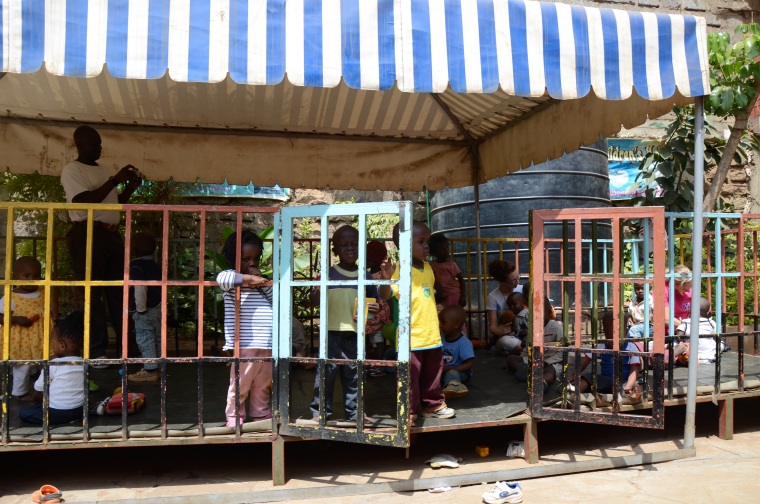
A toddler looks out the window into the yard at the orphanage in which he lives.
Children in this orphanage enjoy play time with orphanage staff and volunteers.
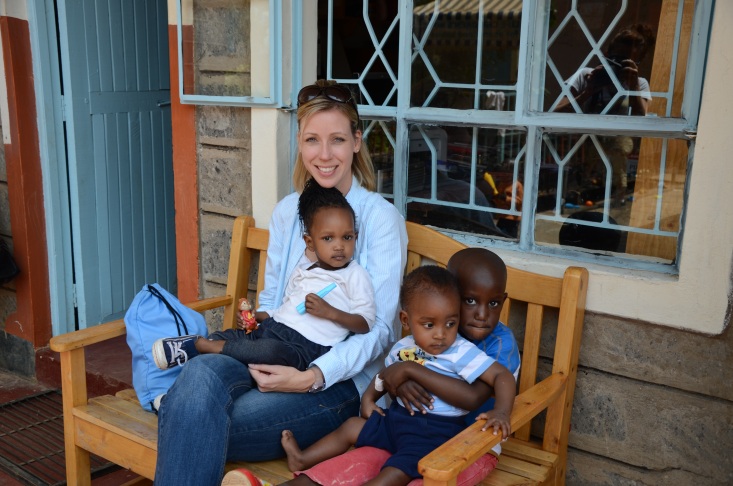
Becky holds a little girl who lives in the orphanage while the child sitting alongside her holds a toddler who also lives there.
Becky visits the top of the Kenyatta International Conference Center overlooking Kenya’s Parliament building with her friend Winnie. Winnie serves on the board of the Kenya Network of Care Leavers. The Kenya Society of Care Leavers is a grassroots youth empowerment movement that promotes the well-being of those who have spent time in institutions in Kenya by creating support groups for young people who have left orphanages in Kenya as well as educates children and youth still in orphanages about their rights.
Jeromy Smith (far left), a U.S. citizen and adoptive parent of Kenyan children was a tremendous support to the East African Orphan Summit leadership and its emphasis on empowering local government and church leadership to promote in-country, family-based care for children in the region. Here he is pictured with the director of Rwanda’s PEACE Plan Initiative as well as two Kenyan attorneys who spoke to the East African Orphan Summit audience about the process and timeline for domestic Kenyan adoptions.
A sign on display at the Nairobi Giraffe Center reminds us that our work impacts generations and that as we work to promote family care so that children in the U.S., Kenya and around the world can thrive, they in turn can change the world.

Former Foster Youth Interns Featured on FamilyLife Today

In a special live edition of FamilyLife Today, hosts Dennis Rainey and Bob Lepine interviewed two former CCAI Foster Youth Interns, Chey Gethers and Mary Lee. Chey and Mary spoke about their lives in the foster care system, the struggles they encountered and the people that helped them get to where they are today.

Chey entered the foster care system when she was a senior in high school. Her parents were alcoholics who abused and neglected her. Chey spent weeks at a time at friends’ houses, until one of her friend’s parents called the Department of Child Services (DCS). When her parents were informed that DCS would be making a home visit, they cleaned up the house and stopped drinking. But as soon as DCS left, things went back to the way they were.

After being kicked out of the house in the middle of the night, Chey called her case manager, who was able to see the reality of the situation and removed Chey from her parents’ care. The system would have put her in a group home because of her age, but Chey’s church decided that the state wasn’t doing enough to help her and they decided to “adopt” her. Her seventh grade Sunday school teacher, Sherry, stepped up to share her home with Chey. At her recent wedding, when the celebrant asked who gave Chey  to be married, the whole congregation stood and said, “We do!” Chey now lives in Nashville and works as an analyst for the FBI.

Chey (right) and Sherry

Similar to Chey, Mary also entered foster care because she had been abused and neglected.  When she was 16, after spending four years in foster care, Mary decided that what she really wanted was a forever family, so she went to court and had the judge terminate her parental rights. She was eligible for adoption at an age that many people considered “unadoptable.”

Mary made a scrapbook of her life to show potential adoptive families. One day, her adoption worker brought Mary a book made for her by a family that wanted to adopt her. When she opened it, she saw that it was the family of her DCS case manager. Now Mary is recently engaged, living in Memphis and working as an attorney and Business Development Specialist for Youth Villages, a non-profit that works with high-risk children and their families.

Mary (left) and her family.

The program’s hosts had a surprise in store for Chey and Mary!  Sherry, Chey’s seventh grade Sunday school teacher, and Scott, Mary’s former DCS case manager and adoptive father surprised them on stage! You can listen to the entire interview (including the surprise!) here: http://bit.ly/SgPuNf