Does privatization of foster care work?

Nebraska’s child welfare system has been a focus of the press lately.  The reason?  They are in the process of privatizing parts of their child welfare system.  The effort to privatize state foster care systems has long been a topic of heavy debate.  Back in 1996, Kansas became the first state to privatize its foster care system.  Florida and Colorado soon followed suit with the goal of increasing the efficiency and accountability of child welfare services.  Other states, such as Michigan and Ohio have privatized parts of their system, such as adoptions.

An op ed was published in late September of last year in the Grand Island Independent which states, “The evidence continues to mount that Nebraska’s move to privatize the foster care system has been an utter failure. Day after day brings more evidence that the system is broken.”  The author cites inadequate funding, lack of communication between foster parents and agencies, and confusion about the process as some of problems.

In October, the Nebraska Foster Parent Review Board wrote a letter to state legislators to raise their concerns.  The letter cites “staff changes, payment delays to foster parents and service providers, documentation issues, difficulties accessing services, visitation supervision issues and delayed permanency.  Based on 340 case reviews conducted by the Board in September of 2010, 34.7 percent lacked home study documentation; 30.6 percent lacked immunization records; 29.4 percent lacked placement reports; and 27.6 percent lacked visitation or other such reports.”

In November, Governor Dave Heineman responded to the many statements, stories, and reports on the topic saying, “I hope everybody realizes what we’ve been doing in the last 40 years hasn’t worked,” Heineman said of child welfare and foster care. “Nebraska has one of the largest percentages of out-of-home placements in America.  […] What is best for the kids is in-home placements, not institutional care.  […]  The idea of reform is to change the system so a large majority of children and families are getting services in their homes, and a minority are being removed from their homes and put in out-of-home placements. The state has opted for a public-private partnership to do that.  […]  The government’s not a very good parent.  I think we have to involve the private sector, nonprofits, charities and others in this effort.  […] It’s real easy to sit there and say, ‘I don’t like the direction this is going,’ but I don’t hear a lot of solutions …”

State legislators are weighing in on this move, saying that there is not enough legislative oversight to the process.  With pressure from constituents wanting to know, “Is it adequately funded? How much private money is being invested? Is it sustainable? And do senators need to address any public policy issues regarding child welfare?”.  The encouraging news is that state legislators are taking action.

Just this month, a state Senator from Lincoln, Sen. Kathy Campbell, who was newly elected to lead the Health and Human Services Committee announced a resolution will be introduced that “would allow the committee to review and evaluate how child welfare reform has been conducted since its beginning, and report to the Legislature.”


Photo credit: FRANCIS GARDLER / Lincoln Journal Star

Adoptions from Russia

In New Zealand, intercountry adoptions from Russia were suspended in 2006 due to changes in Russian legislation amid speculations regarding the well-being of children after their adoptions.  Just the beginning of this month, adoptions from Russia to New Zealand are resuming as a result of a permit granted.  This article reports how one family was just two months away from bringing home their child when adoptions were halted back in 2006.  Another family waited two years and made three trips to Russia in hopes of completing their adoption. These are similar to the frustrations now faced by American families who are currently waiting to adopt a Russian child.

Meanwhile, the needs of Russian orphans remain significant.  UNICEF estimates there are 4 million orphans in Russia who have lost one or both parents.  A New York Time article states, “The percentage of children who are designated orphans is four to five times higher in Russia than in Europe or the United States. Of those, 30 percent live in orphanages. Most of them are children who have been either given up by their parents or removed from dysfunctional homes by the authorities.”

Since June 2010, the U.S. State Department has continued to work with Russia to finalize a bilateral agreement on intercountry adoption.  Russian officials traveled to Washington, DC last month to participate in a fifth round of talks regarding this agreement.  The U.S. Dept. of State’s website reports, “the talks were fruitful, and further progress was made.”  The focus of these talks include ways that both U.S. and Russian officials can ensure that adoptive parents are both better screened and prepared for the realities of parenting.

In addition to the U.S. and New Zealand adoption agreements, Russia began drafting agreements with France, Spain, Britain, Ireland, and Israel last year.

Joy. Hope. Peace. Family.

Happy Holidays from your friends at CCAI!

Dear Friends:

Meet one of CCAI’s Angels in Adoption™, the Merkouris Family. Until earlier this month, U.S. immigration law prevented their two older children from being adopted with the rest of their seven siblings. Recognizing this law as a barrier preventing these children from finding a permanent, loving family, Congress amended this law and now thousands of older children can find homes through adoption.  This is just one of the many examples of CCAI’s work. Every day we are working to identify the legal and policy barriers that prevent children from realizing their basic right to family and ways that federal policymakers might eliminate these barriers.

Sadly, there are still laws and policies that stand between a waiting child and a loving home.  With your generous support, CCAI can bring joy, hope and peace into the lives of orphans and foster children around the world. As the year draws to a close, please consider becoming a monthly or quarterly CCAI partner, or help to fulfill CCAI’s mission by sending in a year-end gift.

Thank you for your past, present and future involvement, without which CCAI would not exist.  Our friends, volunteers, and donors allow us to provide the necessary programs that bring about actual change in the lives of orphans and foster children around the globe. We are so thankful for you. Have a wonderful holiday!

Warm wishes,


Kathleen Strottman

Executive Director

Forgotten Children: International Adoption and the Global Orphan Crisis

The Daily Beast and Urban Zen co-hosted an event called Forgotten Children: International Adoption and the Global Orphan Crisis in an effort to draw attention to the topic.  Experts from the field of orphan care and adoption spoke about the growing need to address the orphan crisis.  This article summarizes the event and includes video clips of the expert panel.

Dr. Jane Aronson who has been nicknamed ‘the orphan doctor’, spoke about the realities of adoption from a health perspective.  She raised the concern that prospective adoptive parents are often not honest with themselves about their abilities related to the needs of the child they are seeking to adopt.  Aronson, along with others, called for better post-adoption services.

Deborra-Lee Furness, co-host of the event, wife of actor Hugh Jackman, and adoptive mother, discussed her view that adoption should be the third best option, after placing a child with their biological family, then placing a child with another family in their home community.

Filmmaker Deann Borshay Liem who was adopted from South Korea when she was 8 years old spoke about the impact of international adoption in her own life.  Her unique adoption story s the focus of two POV documentaries that aired earlier this year on PBS.  Liem raised the point that adopted children grow up, and as an adult adoptee she shared, “I gained tremendously by coming to this country.  But on the other hand, I lost everything I loved by coming to this country”—her family, identity, language, and even memories. “One does not replace the other.”  While sharing this perspective, Liem urged that the best interest of a child it is critical for children to have families and secure homes.

Dr. Sophie Mengitsu, who operates in Ethiopia, offered her suggestion that agencies that help international adoption must also help the communities from which these orphans come.  She went on to highlight the negative impact on development that is caused by living in an institution.

Ultimately, several possible solutions to improve international adoption and the global orphan crisis were raised that range from supporting the struggling communities to examining the root causes to providing better training for orphanage workers.

It is imperative to invest in children around the world, and to not delay in making this investment.

The most wonderful time of the year

The most wonderful time of the year–no, not the holiday season–but National Adoption Month is drawing to a close.  I wanted to use this last Adoption Month post to draw attention to activities that have been taking place this month since my first post on this topic.  I’m excited to share many new activities were started this year, and will hopefully continue to grow in the future to accomplish our shared vision of a family for every child.

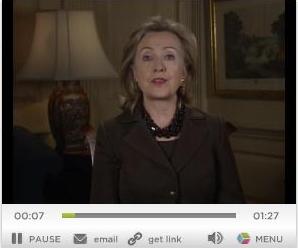
Secretary of State Hillary Clinton commemorated National Adoption Month through a video message in which she highlighted that over the past decade 200,000 children have been adopted internationally.  Secretary Clinton shared that the U.S. Department of State is committed to safeguarding the interests of children, birth parents, and adoptive parents worldwide.  As evidence to this commitment, Secretary Clinton announced early this year the appointment of Ambassador Susan Jacobs as Special Advisor for International Children’s Issues who works to ensure the child’s best interest is the heart of every international adoption.

The global media company Clear Channel celebrated National Adoption Month in conjunction with the Heart Gallery NYC by broadcasting pictures of children waiting in foster care to be adopted on a Times Square screen.  Thousands of New York City residents and visitors learned about the need for adoption.

Tampa Bay Rays’ right-hander, James Shields, along with his wife Ryane are committed to helping children in foster care find homes.  The Shields have worked with the Tampa Bay Heart Gallery for a few years now, recording PSAs and most recently holding a blown-up picture of one of the boys waiting to be adopted on the field.

Voice for Adoption launched their Adoptive Family Portrait Project during an event on Capitol Hill.  During November, Members of Congress display constituent family photos in their DC office in order to raise awareness about foster care adoption.

Joint Council dedicated posts each day on their blog to share one successful adoption story, one unsuccessful adoption story, and one action that individuals can do to help children’s welfare domestically around the world.

Do you know of other unique National Adoption Month activities?  Be sure to comment in order to share information about the great work taking place on behalf of this effort!

National Adoption Day reaches beyond courtrooms

The 11th annual National Adoption Day took place last Saturday, November 20th.  This year brought a number of new accomplishments to this national effort.  This year alone, more than 4,800 children were adopted on National Adoption Day–more than any year before!  Nearly 400 events took place across the country.  While judges, social workers, attorneys, CASAs, volunteers, and most importantly adoptive parents worked together to ensure successful events; celebrities, elected officials, and pro sports are now realizing the importance of this day.

For the first time ever, all 50 governors issued National Adoption Day and National Adoption Month proclamations along with numerous mayors of cities across the country.  President Obama issued his annual proclamation.  State courts, state legislatures, and city councils passed National Adoption Day resolutions.

Once again, the U.S. Senate and U.S. House of Representatives both passed National Adoption Day and Month resolutions with a total of 75 original co-sponsors.

Several elected officials expressed their support by attending events, such as Gov. Deval Patrick of Mass., or by writing op eds such as Rep. Jim Cooper of Tenn., or by issuing press releases, such as Sens. James Inhofe and Mary LandrieuLt. Gov. of New Jersey, Kim Guadagno opened up about her own adoption in an op ed she wrote for the day.

Academy Award nominated screenwriter and actress Nia Vardalos participated in the Los Angeles event by sharing her personal foster care adoption story.  Actor Willie Garson also shared his story of adopting his son from foster care.  Nia served as spokesperson this year, and participated in several interviews on the topic.

The Secretary of Health and Human Services, Kathleen Sebelius, kicked off National Adoption Day by finalizing two adoptions from the D.C. foster care system on Friday, Nov. 19th.  One boy was a 17 year-old who was being adopted by his friend’s mother.  He went on to share what his adoption day means to him through his blog post.

The New Orleans Saints also recognized the importance of the day by playing the National Adoption Day PSA and announcing to the 70,000 fans present at their November 21st game about the need to step forward and make a difference in the life of a child.

Numerous TV stations across the country featured stories about local families’ adoption on National Adoption Day.  In Atlanta, one boy shared what his adoption means to him. “There is no sadness here,” he said of his new home.

While 2010 presented many new successes for foster care adoption, there is much work to be done.  Thank you all for your efforts surrounding National Adoption Day.  We are looking forward to even more forever families to celebrate next year!

For the official National Adoption Day press release, click here.