Press Credentials Are Required for Entry to Events
CONGRESSIONAL COALITION RECOGNIZES KRISTIN CHENOWETH, RHEA PERLMAN, AND EXTREME MAKEOVER: HOME EDITION AS “NATIONAL ANGELS IN ADOPTION™”
Award ceremony in DC October 6
WASHINGTON, DC — The Congressional Coalition on Adoption Institute (CCAI) is hosting its 12th annual Angels in Adoption™ Gala on October 6 in Washington, DC. The 2010 National Angels in Adoption™ honorees are Tony and Emmy Award winning actress Kristin Chenoweth, Emmy Award winning actress Rhea Perlman, and Extreme Makeover: Home Edition. Country music artist Jimmy Wayne will perform “Elephant Ears” a song about his experience as a foster child. These celebrities will join 140 Angels in Adoption™ from across the country who were selected by Members of Congress for their work on behalf of children in need of families. For a complete list of Angels and their states visit http://bit.ly/bCEMEI.
**FOR ADVANCE INTERVIEWS with Ms. Chenoweth, Ms. Perlman, Mr. Wayne, or the Executive Producer of Extreme Makeover: Home Edition, please contact Emily Collins at 202-544-8500 or Emily@ccainstitute.org. **
WHO:
Kristin Chenoweth: Emmy and Tony Award winning actress and foster care adoption spokesperson
Rhea Perlman: Four-time Emmy Award winning actress and longtime child advocate
Jimmy Wayne: Country music singer and songwriter, and former foster youth
Extreme Makeover: Home Edition: built numerous homes for foster and adoptive families
140 Angels in Adoption™ nominated by Congress for their work in foster care or adoption
WHAT:
CCAI is presenting awards to national celebrities and individuals from across the country who work to raise awareness about the 423,000 children in foster care and the 143 million orphans around the world.
WHEN and WHERE:
Wednesday, October 6, 2010
10:00am-10:45am: PHOTO OPPORTUNITY: “ANGEL” FAMILIES FROM ACROSS THE COUNTRY WILL BE PRESENTED WITH AWARDS BY SENATORS LANDRIEU AND CARDIN Dirksen Senate Building Room SD G-50
6:00pm-7:00pm: MEDIA AVAILABILITY WITH CELEBRITY HONOREES, Ronald Reagan Building, 1300 Pennsylvania Ave, NW, Washington, DC
7:00pm-9:00pm: PHOTO OPPORTUNITY: ANGELS IN ADOPTION™ GALA, Ronald Reagan Building, 1300 Pennsylvania Ave, NW, Washington, DC
Two of CCAI’s 2010 Foster Youth Interns, Sam Martin and Wendy Ruiz will appear along with Sens. Chuck Grassley (R-Iowa) and Mary Landrieu (D-La.) on the Dr. Phil Show tomorrow, Friday, October 1st. The show will focus on the need to improve outcomes of older youth in care and those aging out to live on their own without the necessary supports. Be sure to tune in! Check your local listings here.
There are hundreds of thousands of children in foster care right now. Many are the silent victims of abuse and neglect, spending their entire childhoods being tossed from house to house, slipping through the cracks in the foster care system. Dr. Phil gives a voice to the children who feel thrown away and unloved. Find out how you can help a child in need! And, Cindy and Mick are well-intended parents of adopted sisters, Danielle, 13, and Marie, 11. They say they struggle to parent their oldest daughter, who lies and is very angry. Dr. Phil gives a powerful demonstration of what it’s like for kids in foster care, and what they deal with even after they are placed in a permanent, loving home. Then, meet Stacy, 19, who entered foster care at 10 and endured years of horrific abuse before aging out of the system at 18. She struggles to find resources to help her in college. Dr. Phil has several amazing surprises for the teen! And, Dr. Phil and Robin are national spokespersons for Court Appointed Special Advocates (CASA). Learn how to become a CASA and help change a child’s life!
The day after we toured several sites in Addis Ababa and met with various U.S. and other government leaders, we headed out to spend the beginning of our second full day on the ground in a rural area named Bantu – the home area of Ethiopian President Girma Wolde Giorgis.
Our delegation arrived to the Buckner Bright Hope School in Bantu to find the 400 school children and many of their families and members of the Bantu community were also there to greet us. The children were singing “Welcome, welcome,” and clapping when we arrived.
A local Ethiopian Orthodox Church choir performed a traditional and ancient song and dance, and then Senator Landrieu, Ambassador Jacobs, and Gary Newton spoke briefly with community elders.
Then our entire group visited some of the school’s classrooms and watched a few demonstrations of the children’s math and English-speaking skills.
It was very interesting to me to note how the school is now the focal point of the community of Bantu. The school actually feeds the children who attend two meals a day and provides them stipends for uniforms. At one point, I asked the Director of Buckner Bright Hope, Getahun Tesema, how many sibling groups attend the school, and he told me that only one child from each family in the community is able to attend because parents are unwilling to send all their children away from their housework. I then asked Getahun how the school staff choose which child from a family to attend – Did they select the oldest? Youngest? Smartest? He explained to that they choose the weakest and most malnourished child in the family so they are fed the two daily meals the school offers and thus have a better chance of surviving childhood. It was a humbling reminder to me of the vast needs families in Ethiopia face, that the school would use malnutrition as it’s guiding factor in approaching enrollment.
Back to School, Back to Instability: New Study Shows Foster Children Struggle in Math, English and Other Standardized Tests
Bipartisan Group of Hill Leaders and DC ‘Real Housewife’ Stacie Scott Turner Call for Change, Equal Opportunity
WASHINGTON, DC — As families engage in familiar back-to-school rituals, early new data shows that the educational playing field is not level for children in foster care, whose academic careers are often impacted by multiple school relocations. Foster youth persistently score lower than their peers in all educational measures. The Congressional Coalition on Adoption Institute (CCAI) and Fostering Media Connections (FMC) today released preliminary findings from a pilot program conducted by the California Partnership for Achieving Student Success (Cal-PASS) which indicate that foster youth in four counties in California are less likely than their closely matched peers and the general student population to achieve proficiency in English and math at all grade levels.
Sample preliminary results found that one in 10 foster youth are proficient in math by the 11th grade; just over two in 10 foster youth will be proficient in English by the 11th grade. The full findings of the Cal-PASS pilot project will be released this winter. In reviewing the preliminary results of this study and others like it, Senators Mary Landrieu and Chuck Grassley, Representatives Jim McDermott and Michele Bachmann, and former foster child turned reality TV personality Stacie Scott Turner called on Governors, their fellow Members of Congress and the Administration to take immediate action to reverse this disturbing trend.
The compelling testimony of two former youth helped to put a face on the reality the numbers represent. Sokhom Mao was placed in a stable environment, protected by a 2004 California law that requires that youth in care have the chance to stay in the same school despite a change in placement. “While in foster care, it was very important to not change schools while I was changing placements. That stability allowed me to graduate from high school successfully and helped me retain my entire high school course curriculum. That landed me in San Francisco State University, where I graduated with a Bachelor’s in Criminal Justice.” Conversely, Christina Miranda told of attending 10 different schools, four different schools in high school alone. “I remember moving a lot and that was pretty painful. I had the realization that I wasn’t a normal student with a normal life. I remember feeling like there was no reason to try because I knew I was going to leave anyway.”
Former foster child and star of Bravo’s Real Housewives of DC Stacie Scott Turner shared her story and those of the children she counsels through Extra-Ordinary Life, a program for girls in foster care. “Many people don’t understand what foster children face: an unstable home, lack of parental influence and moving from place to place makes focusing on school five times as difficult. When we can ensure foster children are supported and nurtured and can focus on education we will start to see results and level the playing field between them and a general population that often takes their stability and education for granted.”
“While lower educational outcomes always signal a need for reform, what makes these numbers even more disturbing is we know they do not accurately reflect these youth’s academic potential,” said Kathleen Strottman, Executive Director of the Congressional Coalition on Adoption Institute. “The fact that they can perform at all, in light of the constant changes in school and other trauma in their lives, is alone a testament to their ability.”
On average, foster children move to new foster homes and into new schools one to two times per year,” said Sen. Mary Landrieu (D-La.), co-chair of the Congressional Coalition on Adoption and Senate Caucus on Foster Youth. “I have met youth who have attended over 10 high schools in four years. Research has shown each move can set students back as many as six months academically, and leads to increased dropout rates. Fortunately, this is a problem that has a solution. Building upon the Fostering Connections to Success Act, which calls for an increased focus on school stability, Congressional advocates of foster youth have drafted several pieces of legislation mandating that state and local education agencies work in coordination with child welfare agencies to eliminate enrollment delays and difficulties in transferring course credits. Senator Franken’s Fostering Success in Education Act, in particular, is a great example of legislation that would ensure that both education and child welfare entities take responsibility for the educational outcomes of youth in care.”
“One of the primary goals of the Senate Caucus on Foster Youth is to get these kids involved in shaping the policy that affects them. We’ve heard firsthand from foster youth how hard it is to stay in the same school. A foster youth might get a new placement that’s a few miles from his current school, yet have to switch schools because of school district rules. New schools don’t always accept paperwork from the old school. Congress needs to look at whatever can be done to ease the burden on these kids and help them make healthy, lasting connections. And we’ll continue to hear from the kids themselves as we move forward on policy,” said Sen. Chuck Grassley (R-Iowa).
“For children who have been separated from their families and brought into foster care, the need for stability is critical. Teachers, coaches, and classmates can provide comfort and a sense of continuity for foster care youth, making it imperative that every effort is made to keep these children in their school of origin. The upcoming reauthorization of the Elementary and Secondary Education Act is an opportunity to make educational stability a reality by ensuring federal education law includes the parallel protections to the child welfare protections enacted in Fostering Connections,” said Congressman Jim McDermott, (D-Wash.), sponsor of the Fostering Connections to Success and Increasing Adoptions Act.
“As a foster parent of 23 children, I understand the unique challenges foster children face. Many of them have endured difficult situations and face uncertainty at every turn. Stability can be found for these children through a daily routine, friends at school, and teachers who are familiar with their individual needs. That’s why I introduced the bipartisan School Choice for Foster Kids Act which would allow foster parents to send any foster child to his or her original school through education vouchers from the Chafee Foster Care Independence Program. Our nation’s foster children must be given an opportunity to succeed in spite of the hardships they experience,” said Congresswoman Michele Bachmann (R-Minn.).
“I hope the Cal-PASS study will help us stay focused on the need for education and child welfare systems to work side by side to improve educational outcomes for children in foster care. Together we can ensure that hundreds of thousands of children in foster care have the same opportunity for a stable, secure education as their classmates and friends,” said Molly McGrath
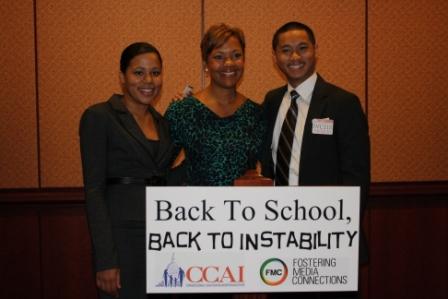
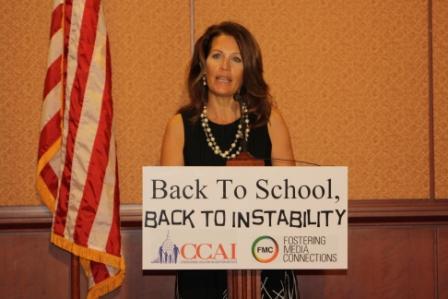
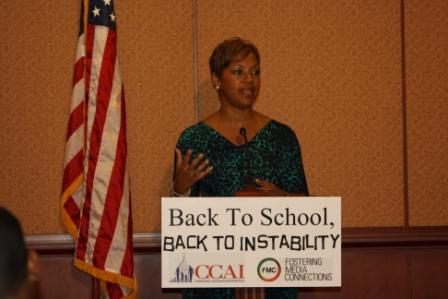
Stacie Scott Turner with former foster youth Christina Miranda and Sokhom MaoSenator Chuck Grassley (R-IA)Congresswoman Michele Bachmann (R-Minn.)Congressman Jim McDermott (D-Wash.)'Real Housewife of DC' and former foster child Stacie Scott TurnerFrom left: Daniel Heimpel, Sokhom Mao, Molly McGrath, Kathleen Strottman, Christina Miranda, Stacie Scott Turner, Jason Turner
Back to School, Back to Instability: New Study Shows Foster Children Struggle in Math, English and other standardized tests
Bipartisan Hill Leaders and DC ‘Real Housewife’ Stacie Scott Turner Call for Change, Equal Opportunity
Washington, DC— As millions of hopeful children engage in familiar back-to-school rituals, early new data shows that the educational playing field is not level for children in foster care, whose academic careers are often impacted by multiple school relocations. Foster youth persistently score lower than their peers in all educational measures. The Congressional Coalition on Adoption Institute and Fostering Media Connections will release new data that supports their call to action at a press conference on Thursday, September 23rd from 12:00—1:00PM in Washington, D.C. at the U.S. Capitol Visitor Center, room SVC 215.
WHO:
Sen. Mary Landrieu (D-La.): Co-Chair of the Senate Caucus on Foster Youthand Co-Chair of the Congressional Coalition on Adoption
Sen. Chuck Grassley (R-Iowa): Founder and Co-Chair of the Senate Caucus on Foster Youth; Ranking Member of the Finance Committee which oversees child welfare financing.
Rep. Jim McDermott (D-Wash.): Sponsor of the Fostering Connections to Success and Increasing Adoptions Act.
Rep. Michele Bachmann (R-Minn.): Sponsor of the School Choice for Foster Kids Act and foster mom.
Stacie Scott Turner: Star of Bravo’s Real Housewives of DC, former foster child and founder of Extra-Ordinary Life, which provides a new outlook on life for girls in foster care.
Sokhom Mao: Former Foster Youth from California who benefited from state law that ensures educational stability.
Christina Miranda: Former foster youth who experienced three moves in elementary school, three in middle school and an additional four in high school.
Molly McGrath: Baltimore City Department of Social Services Director who outlines the need for collaboration between education and child welfare.
WHAT:
As children head back to school, this event will identify the factors that impact educational outcomes for youth in foster care, and ways the federal government might act to address them.
WHEN:
Thursday Sept. 23, 2010 from 12:00PM—1:00PM
WHERE:
U.S. Capitol Visitor Center SVC 215
CONTACT:
For more information about the event, please contact Daniel Heimpel with Fostering Media Connections at 510.334.8636, or dheimpel@fosteringmediaconnections.org.
Just the other week, the Children’s Bureau released new AFCARS data. The below chart taken from their website shows the data trends from FY2002- FY2009.
I was looking over the data with my colleague, and being a numbers guy (our finance director to be exact) David and I decided to look a little closer at the numbers. We noticed two significant trends:
1) Why are so many more children being adopted out of foster care than ever before?
Between 2002-2009, the number of children waiting to be adopted decreased from 134,000 to 115,000. However, the number of children adopted with public child welfare agency involvement actually increased from 51,000 to 57,000 over the same time period.
This represents a substantial increase in the percentage of children waiting to be adopted who were actually adopted. In 2002, only 34% of waiting children were adopted but by 2009 that had increased to over 49% of waiting children who were adopted. The AFCARS data also shows that the percentage of children in care whose parental rights have been terminated and were then adopted increased from 68% to 81% between 2002 and 2009.
The problem is that no real answer exists for this question. Several factors may be influencing this decrease in the number of waiting children and the spike in adoptions out of foster care:
Policies continue to improve to promote more efficient processing of adoptions. This is in response to efforts to minimize time in care or prevent placement in foster care.
Over the past few years, adopting internationally has increasingly become more difficult due to changes in foreign country’s own adoption practices. According to the State Department, international adoption is down from a high of almost 23,000 in 2004 to under 13,000 in 2009.
2) Why are there so many less children in foster care now?
Between 2002-2009, the number of children in foster care decreased by almost 100,000 from 523,000 to 424,000. The number of children entering care has decreased by as little as 7% or as much as 17% each year. This is due in part to increasing programs and funding to assist families and keep children out of the system.
In an Associated Press article examining this topic, Richard Wexler of the National Coalition for Child Protection Reform shares, “Now, finally, it’s sinking in that most cases labeled ‘neglect’ — the single largest category of maltreatment — are really poverty, and it makes more sense to try to deal with the poverty than destroy the family.”








 Congressional Coalition on Adoption Institute