Federal and state lawmakers discuss strengthening child welfare

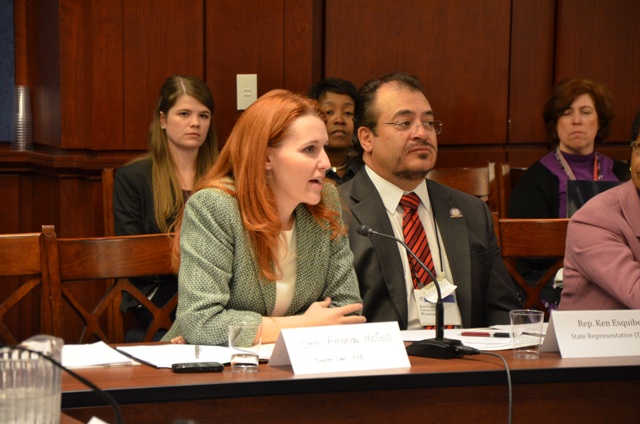
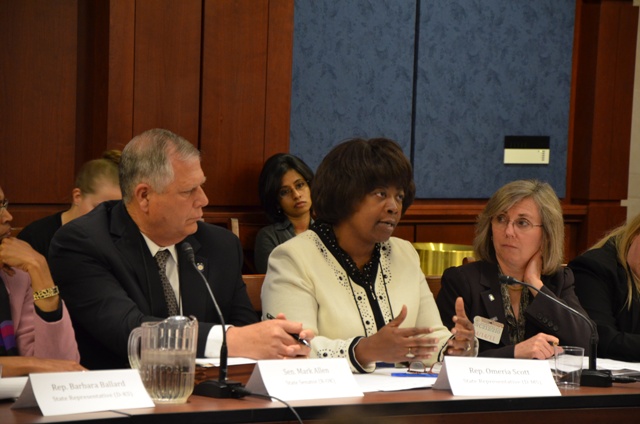
CCAI and the National Conference of State Legislatures (NCSL) were pleased to host a policy roundtable between Members of Congress and state legislators on child welfare.  In this hour long discussion, both state and federal policymakers were given the opportunity to discuss ways in which the federal and state partnership in child welfare is working to protect children and ways in which it might be strengthened to better serve youth in the future.

Diedra Henry-Spires (Senate Finance Majority) and Becky Shipp (Senate Finance Minority) outlined what issues they expected to be on the Congressional agenda for the 112th Session and encouraged state lawmakers to provide insights on issues such as federal financing of foster care, Title IV-E Waivers, and the reauthorization of Promoting Safe and Stable Families program and Temporary Assistance for Needy Families.  Overall, it was a wonderful beginning to what the group hoped would be an ongoing dialogue on issues near and dear to the hearts of all in attendance.

In attendance were Sen. Mary Landrieu (LA), Rep. Karen Bass (CA), Rep. David Cicilline (RI), Rep. James Langevin (RI), State Sen. Willie Simmons (MS), State Sen. Leslie Nutting (WY), State Sen. Mark Allen (OK), State Sen. Amanda McGill (NE), State Sen. Kim David (OK), State Sen. Tom Hansen (SD), State Sen. Juan Pichardo (RI), State Rep. Tom Burch (KY), State Rep. Terie Norelli (NH), State Rep. Ken Esquibel (WY), State Rep. Mary Stuart Gile (NH), State Rep. Sara Feigenholtz (IL), State Rep. Barbara Ballard (KS), State Rep. Betsy Butler (CA), and State Rep. Omeria Scott (MS).

Representatives from the offices of Sen. Chuck Grassley (IA), Sen. Dick Durbin (IL), Sen. John Barrasso (WY), Sen. John Kerry (MA), Sen. Jack Reed (RI), Sen. Frank Lautenberg (NJ), Sen. Mike Enzi (WY), Sen. Pat Roberts (KS), Sen. Sheldon Whitehouse (RI), Rep. Dave Camp (MI), Rep. Jim Cooper (TN), Rep. Jim Sensenbrenner (WI), Rep. Dave Reichart (WA), Rep. Jason Chaffetz (UT), and Rep. Erik Paulsen (MN), and state representatives from the offices of Speaker John Perez (CA), the Executive Director of the Select Committee on Children & Youth (TN), the General Assembly’s Commission on Children (CT), the Senior Staff Attorney of the Legislative Council (WI), and the Director of the National Black Caucus of State Legislators were in also attendance.

Visit CCAI’s website to read about the conversation that took place between these federal and state legislators.
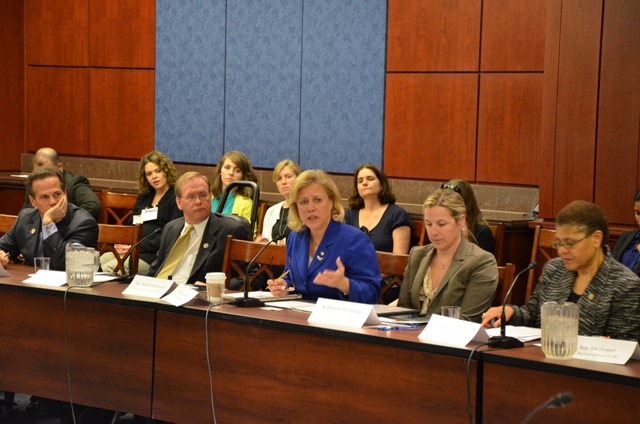
From Left: U.S. Rep. Cicilline, U.S. Rep. Langevin, U.S. Sen. Landrieu, Kathleen Strottman of CCAI, U.S. Rep. Bass
State Representative Barbara Ballard (KS)
State Senator Amanda McGill (NE)
State Representative Omeria Scott (MS)
State Representative Ken Esquibel (WY)

April is Child Abuse Prevention Month

Child Abuse Prevention Month is recognized each April as a way to raise public awareness about child abuse and ultimately support families and protect children.  The CDC highlights that, “approximately 772,000 children are confirmed by Child Protective Services each year as being abused or neglected. These confirmed cases, however, represent only a fraction of the true magnitude of the problem.”  While the majority of these families will receive services to promote healthy family functioning and ensure the children can remain safely st home, over 250,000 children will enter foster care each year.  It is important for policymakers and practitioners to understand how to best serve families in need to promote healthy families and avoid placing children in foster care when possible.

This year, the theme of Child Abuse Prevention Month is “Strengthening Families and Communities.”  Recognizing the importance of identifying risk factors and building upon the strengths that already exist in the family and community, the 2011  Child Abuse Prevention Resource Guide serves as a tool for practitioners working with families.

In preparation for this month, the Child Welfare Information Gateway updated its site on preventing child abuse, where information on positive parenting, community resources, and preventative programs is available.  One organization, Parents Anonymous, announced the launch of a national hotline and website meant to provide emotional support and resources to parents.  Yesterday, the White House showed support by issuing a Presidential Proclamation in support of Child Abuse Prevention Month.

How will you raise awareness about child abuse prevention this month?

Our Nation’s Future Begins At Home.

Photo Credit: CDC

CCAI releases ‘What Barriers Remain for the 112th Congress’

Kathleen Strottman, CCAI’s Executive Director, authored a report highlighting what areas of reform the 112th Congress may consider addressing this legislative session.  The report discusses several issues advocates, families, and professionals alike have raised.  Visit our website or click here to read the full report.

In keeping with CCAI’s mission to not only identify instances where policies are standing in the way of children finding their forever families, but more importantly to highlight ways that policymakers might act to eliminate them, CCAI raises areas where reform is needed.  A few of the topics covered in the report include:

  • Another Planned Permanent Living Arrangement (APPLA):  With 30,000 youth aging out of foster care each year having never been adopted, advocates have suggested that federal policymakers begin to study the frequency and reasons for recommending APPLA as a permanency plan for a foster youth.
  • Adoption Affordability:  We also know from the National Survey of Adoptive Parents that 57% percent of adoptive parents surveyed reported being at or below 300% the federal poverty line ($67,050 for a family of four).
  • Universal Accreditation:  Where the Intercounry Adoption Act falls short is that it only applies to adoptions between countries that are both parties to the Hague Convention, meaning that if an adoption is between the U.S. and a non-Hague country such as Russia or Ethiopia, the agency performing the adoption does not have to be accredited and the family involved is left without the corresponding services and protections.

Social workers make a difference…

Throughout March, Social Work Month is being celebrated by social work professionals and students across the country.  I wanted to take this opportunity to highlight how social workers are helping children to remain a part of or find safe and loving families.

One of our former Foster Youth Interns, Christina Miranda, recently spoke at our New Congress Forum to address legislative priorities for this Congress.  One of the areas needing reform that she highlighted was the child welfare workforce.  Christina said that social workers and caseworkers need more support to achieve the goals of their positions.  “Social workers have a major influence on making critical and life changing decisions for families and youth.  They need to have skills and training to inform their decision-making and ultimately promote the best interest of children and families.”

Christina went on to explain that as a social worker herself, she has seen the qualifications for caseworker positions vary from state to state, or even between different regions of the same state.  “In some localities, you have social workers with a Master of Social Work degree, but in other areas, you have caseworkers doing the same job, but with a Bachelor’s degree in Art.”  These caseworkers do not have the educational background to inform their work.

Survey results published in 2005 by APHSA on the child welfare workforce showed that:

  • nearly 10% of all child welfare worker positions remain vacant, which requires existing workers to maintain higher caseloads than national or state standards
  • the average child protective services worker’s tenure is about 3 years, meaning that some workers are “in foster care” less time than the children they serve
  • the average incumbent child welfare caseworker’s salary was about $35,000, which is less than teachers, police officers, firefighters, or other public service positions

While supporting and developing the child welfare workforce is an important part of child welfare reform and promoting better outcomes for youth in care, Christina did not see specialized professional training and support end with social workers.  “Everyone from child protection to child welfare administration, from guardian ad litems to family court judges, from state legislators to Members of Congress need to be aware of issues affecting children in foster care.”


Perspectives on this Congress’ legislative priorities

In an article from last week, CCAI’s shared in part the discussion that took place at our 112th New Congress Forum where Members of Congress addressed their legislative agendas for this year.  It was a vigorous and insightful hour-long discussion.  Perhaps the most captivating out of all of the speakers at the round table were the individuals who had direct experience with the foster care system or domestic and intercountry adoption.

Alixes Rosado bravely began with his story explaining while life on the streets was tough he felt the streets were safer and more loving than some of his foster homes.  After hearing this, Sen. Mary Landrieu expressed her interest in working to improve the foster parent recruitment processes across the nation to promote quality homes and better support foster parents.

Christina Miranda, also a former foster youth, changed schools 6 times between the age 11 and 18, and discussed the difficulties this school instability posed to her educational success.  Rep. Michele Bachmann highlighted a piece of legislation she introduced last Congress and plans to continuing working on, “School Choice for Foster Kids Act which would allow foster parents to send any foster child to his or her original school.”  To this, Sen. Landrieu said she would introduce a companion bill in the Senate to encourage the passage of this law.

Panel of individuals who shared their personal stories.

Samuel and Mildred Stewart adopted 3 children from foster care.  They stressed the need for mental health services to be provided to adopted children, as they have and continue to struggle to find services for their son.  She suggested how helpful it would be for families if parents had services, such as support groups or respite care.

International adoptive parent, Jeromy Smith, told his moving story of adopting his daughter and son from Kenya.  “Orphans struggle not only with physical poverty, but with relational poverty. Every night millions of kids—both those with empty stomachs and full stomachs—go to bed wondering if anyone, anywhere will ever love them.  Their souls ask the question, ‘Do I even matter?”  Read his full remarks here.

Nicole Dobbins, Executive Director of Voice for Adoption and former foster youth, stated, “I sometimes have to pinch myself when I say ‘executive director’ because it is hard for me to believe sometimes, when I think about where I have come from. I am delighted to share in the context of both my professional and personal capacity, if it will help push the agenda on foster care and adoption policy, because waiting children truly deserve to be at the forefront of every discussion.”  Read her full remarks here.

Executive Director of C.A.S.E., Debbie Riley shared that from her experience as both an adoptive mother and adoption  professional, “according to adoptive parents, one of the greatest post-adoption support needs is mental health services provided by someone who knows adoption.”

These speakers brought most of the room to tears with their personal stories and helped Members realize that the 112th Congress has some work ahead of them to improve foster care and adoption.  Members shared their commitment to use their position to bring about change for these children and families.

It’s budget season…

Reports have been published that show spending money on children and youth in foster care today will save significantly in the future by lowering rates of incarceration, welfare dependence, homelessness, and the need for other public services.  However, elected officials are not looking years down the road when they are plagued by such budget shortfalls today.

Here on the Hill and in states and localities across the nation it’s budget season.  Last month President Obama sent his proposed FY2012 budget to Congress.  However, Congress hasn’t yet passed a spending bill for the remaining 7 months of FY 2011.  Just yesterday they passed a continuing resolution for 2 weeks to avoid a federal government shutdown set to take place this Friday.

With all of the uncertainty surrounding federal spending, and the vast state and local budget shortfalls, one thing is for sure–child welfare programs are at risk.

While ultimately budget decisions are left up to Congress, the President’s budget proposes slight decreases in overall discretionary funding for child welfare programs.  First Focus released a report outlining the proposed changes to child welfare funding.  “Among the most notable aspects of the budget is the inclusion of an increase in funding of $250 million in mandatory funds in FY 2012 to support a reform agenda focused on providing incentives to states to improve outcomes for children in foster care and those who are receiving in-home services from the child welfare system. This increase is part of the Administration’s broader proposal to provide $2.5 billion over ten years to support a comprehensive child welfare reform proposal aimed at making improvements in the foster care system to prevent child abuse and neglect and keep more children safely in their homes and out of long-term foster care.”

Elected officials across our nation are met with the challenge of funding necessary services and programs to serve the needs of their constituents.  It is important to remember that budgets are not really a matter of dollars and cents, but a matter of how the well-being of lives will ultimately be impacted.  A good reminder of this is a quote by Hubert H. Humphrey which is imprinted on the wall at the U.S. Health and Human Services building, “It was once said that the moral test of government is how that government treats those who are in the dawn of life, the children; those who are in the twilight of life, the elderly; and those who are in the shadows of life, the sick, the needy and the handicapped.”

In an op ed byPaul Krugman appearing in the New York Times, Krugman raises some tough questions about the impact of budgets and spending on America’s children.  “When advocates of lower spending get a chance to put their ideas into practice, the burden always seems to fall disproportionately on those very children they claim to hold so dear.”  While Krugman discusses the child population in general, we all know that children and youth in foster are even more vulnerable to poor outcomes and have a higher level of need for government programs.

Krugman asks, “The really striking thing about all this isn’t the cruelty — at this point you expect that — but the shortsightedness. What’s supposed to happen when today’s neglected children become tomorrow’s work force?”

Photo Credit: photographer Vik Orenstein