CCAI Welcomes Delegation of Guatemalan Officials

kathleen_guat_del
CCAI Executive Director, Kathleen Strottman, on a delegation to Guatemala.

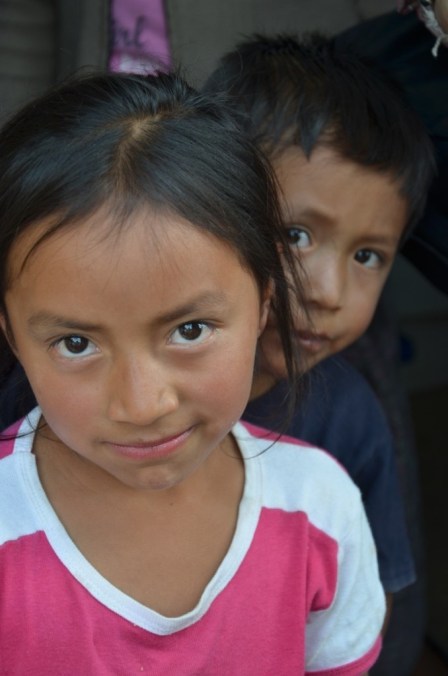
Three months after I became CCAI’s Executive Director I received a call from a frantic mother whose son’s orphanage, Casa Quivera, had been raided by the Guatemalan authorities the night before.   The raid, she was told, was a part of the Guatemalan government’s effort to investigate the orphanage director whom they believed engaged in corrupt practices. Over the next year, I met hundreds of other parents whose adoptions had become immersed in a sea of similar investigations while their children languished in orphanages.

It was under this lens that our focus on the child welfare system in Guatemala began. We would soon learn that the passage of the 2007 Adoption law, although a necessary step, has presented two very real challenges for the Guatemalan government.  First, it left hundreds of children whose international adoptions were not complete in legal limbo.  Without a clear path forward, these cases underwent investigation after investigation. Six years later, approximately one hundred of these adoptions remain incomplete today.  Secondly, it required that the Guatemalan government invest time, money and resources in developing domestic alternatives for children in need of family care.
Guat_girlboy

Our first step was to raise awareness among Members of Congress about these challenges and to enlist their support in advocating for change. We are proud to have partnered with the Joint Council for International Children’s Services (JCICS), the National Council for Adoption (NCFA) and Guatemala 900 to host several briefings on the status of pending cases.  Once we had the support we needed from the US Department of State, US Citizenship and Immigration Services (USCIS) and nearly 100 Members of Congress, we began to bring this support to bear in Guatemala.

Over the past two years, CCAI has been part of five high-level delegations to Guatemala.  Through these visits we have not only had the chance to advocate for the rights of the children unnecessarily trapped in orphanages, but we have also had the chance to learn more about the Guatemalan government’s efforts to build a Hague-compliant system of child welfare. There is undoubtedly a lot that still needs to be done in this regard.  Yet at the same time, the Guatemalans have been aggressive in their efforts to put in place a new system, one that is less reliant on institutional care.

Late last night, CCAI welcomed 14 delegates from Guatemala’s courts, governmental agencies and universities to Washington, DC. We have invited these individuals to participate in our Pathways to Permanency project because of their direct involvement in the welfare of children in Guatemala.  Our hope is that this exchange will inspire these individuals to become agents of change in their own communities.  The week ahead will be filled with presentations by US experts in child welfare; conversations among judicial colleagues; meetings with Members of Congress and the Administration and lessons in best practice from other regional models.

I have many hopes for the week ahead, but chief among them is this: that everyone who participates in this week comes away with a deep desire to see every child in Guatemala have a safe, loving and permanent family to call their own.  I hope that they will see that achieving this goal requires the use of all options for permanency.  And most importantly, I hope that like those of us at CCAI, they will be willing to work to remove every barrier that stands in the way of this hope becoming reality.
Guat_2girls

Investing in the Future of our Children

WaPo_Print_Ad-_Who_Is_More_Important
Image Courtesy of The Next Generation

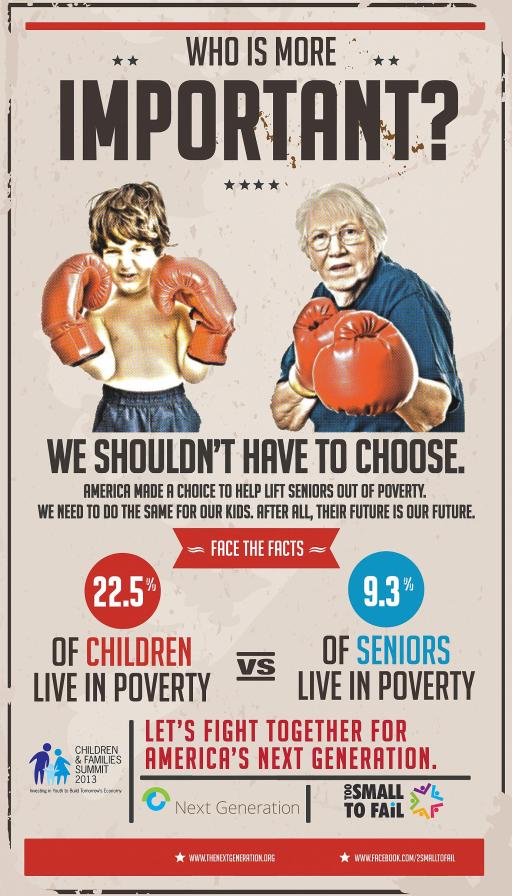
Yesterday, the Washington Post, The Next Generation and the W.K. Kellogg Foundation hosted the “Children and Families Summit 2013,” a convening of parents, policymakers, and experts unified in their belief that our nation not only can, but must, do better at investing – personally, privately and publicly – in the future of our children. The day’s agenda focused on a relatively simple and yet profound question: How can we as a nation strengthen support systems for those young people and parents who desperately need them?

As this important conversation continues,  we must remember that hidden within the millions of children who live in poverty, lack access to a high quality education, or suffer unnecessarily from chronic health conditions are our nation’s  half a million foster children. In taking these children into our governments’ care, do we not also make an implied promise to provide them the attention and support they need to become successful, stable adults?  Most would say the answer to this question is unabashedly yes, and yet what research shows is that foster children are chief among those falling through the gaps in our current system.

Here are just a few sobering facts: according to the American Academy of Pediatrics, compared with children from the same socioeconomic background, children in care have much higher rates of serious emotional and behavioral problems, chronic physical disabilities, birth defects, and developmental delays. Educational attainment studies reveal that less than 50% of youth in care graduate from high school and only 3% go on to get a college degree. As if those statistics are not compelling enough, studies also show that as many as one in four foster youth will end up homeless, in jail or die within a year of leaving care.

There are many reasons why children in foster care are not achieving their potential; I would like to focus on just two. First, as Paul Tough explains in great detail in his new book, How Children Succeed, “what matters most in a child’s development… is not how much information we can stuff into [a child’s] brain in the first few years. What matters instead is whether we are able to help [them] develop a very different set of qualities; a list that includes persistence, self-control, curiosity, conscientiousness, grit and self-confidence.”  According to Tough, it is these skills, and not the accumulation of book knowledge, that are what allows students to maintain focus during a difficult exam or get noticed for having a “good work ethic” in the workplace.

And who is it whom most often helps cultivate such skills in children? Good parents.  In fact, one of the most compelling parts of yesterday’s events for me came during the remarks of sixteen year old Alfa Lopez who introduced the Secretary of Education to the audience. Lopez said what an “only in America” moment it was for her—a  Los Angeles teen who hails from a low income neighborhood with a school dropout rate over 50%—to be in Washington, D.C. and introducing such an important government official. She opened with “Thanks to my parents, who sacrificed everything to give me what they never had.”

Not only do foster children not have the benefit of being raised by the type of parents who lead to success stories like Alfa, we are also failing to provide too many youth that type of parenting while in care.   We currently have one foster family for every four children who need care and a high number of those who are fostering are doing so for all the wrong reasons.  Foster children move from home to home almost as often as the seasons change and the vast majority of teens in foster care are growing up in group homes, many of which resemble prisons, not families.  One way to bring about change for children  would be to invest in systems that allow children to go from broken homes into supportive settings with caring adults who are willing and able to build the skills celebrated by Tough.

The second reason foster youth continue to struggle is that major federal programs designed to meet the needs of disadvantaged children in general too often miss the mark in meeting the needs of children in care.  Here are just some examples: one third of all children in foster care are under five years old when removed because of abuse and neglect.  Because they are in care they are categorically eligible for Head Start Services, and yet according to the National Study on Child and Adolescent Well Being, only 6% of children in foster care are enrolled in this important program. Similarly, although foster youth are three times as likely as the general population to be identified as being in need of special education services, they are half as likely to receive them.  Foster youth are less likely than their counterparts to be enrolled in federally-supported, school-based enrichment programs such as after-school activities or mentoring initiatives.

Why is this?  Again, there are many reasons but one of the main problems is that most of these programs rely on a parent—or at least an adult acting like a parent—to enroll these youth in these programs.  Youth in care are most often represented by social workers who have a long list of things they are supposed to be doing for the children in their caseload and often lack the time, expertise and resources needed to accomplish these goals. Foster parents, as discussed before, are also not ably fulfilling this role.  So the programs exist to help youth in care, they are just not currently doing so.

These are the types of questions CCAI strives to provide answers to everyday.  We look forward to working with Next Generation, the Washington Post and all of the committed partners who attended the event yesterday.   As my former boss Senator Landrieu used to say, “Children might only constitute thirty percent of America’s population, but they are undeniably 100% of America’s future.”

How the Adoption Incentives Program can Incentivize Adoptions

Today, the Subcommittee on Human Resources of the Committee on Ways and Means held a hearing to review the success of several privately run programs to increase the number of children adopted out of foster care. This marks the beginning of the committee’s efforts to review—and hopefully reauthorize—a federal program entitled the Adoption Incentives Program.  Originally created in 1997 as part of the Adoption and Safe Families Act, the Adoption Incentives Program has delivered a total of $375 million in bonuses to states that were successful in increasing the number of children adopted out of foster care.

Subcommittee on Human Resources of the Committee on Ways and Means Adoption Incentives Hearing.

Since the inception of the Adoption Incentives Program, more than half a million children found their forever homes. Despite this success, however, over 100,000 foster children are still waiting to be adopted.  If trends continue, approximately 50% of these children will succeed in finding homes through adoption and 50% will continue to wait.  Statistics reveal that those who remain waiting are most often older children, members of larger sibling groups or those children who have special physical or mental health needs.  In fact, according to a the most recent AFCARS report, the average age of a child adopted out of foster care is 6, while the average age of a child waiting to be adopted out of care is 8.

So the question before Congress is this: how can the federal government incentivize states to find a home for every child? The programs highlighted in today’s committee hearing prove beyond a shadow of a doubt that there is no such thing as an unadoptable child, just an unfound family.   There are at least three lessons to learn from these programs’ experiences.

  • States cannot employ “a one-size-fit-all” strategy for finding a permanent home for a child.  Efforts to recruit an adoptive family for a child must be as diverse as the children themselves.
  • States that have succeeded in finding homes for older and special needs children have done so in close partnership with community and faith-based partners.  Such partnerships allow state child welfare agencies to be more innovative in their approach; address critical workforce gaps; increase their reach into communities where perspective adoptive parents are likely to be found; and provide post- adoption support.
  • Finally, success in finding an adoptive family for every child who needs one is premised on the belief that all children need and deserve a family

If Congress hopes to replicate the successes of the types of programs highlighted today it must learn from these lessons and better incorporate them into the current Adoption Incentives Program.  Congress might also want to consider whether the current model of providing an individual bonus per adoption is the best way to incentivize adoption for older and special needs children. Perhaps this group would be better served by a model similar to the Department of Education’s “Race to the Top,” a federally-funded contest which provides funds to states that successfully put forward groundbreaking, thoughtful plans to address four key educational reform areas.  While the full effects of “Race to the Top” remain to be seen, preliminary findings indicate that it has been successful in spurring innovation and improving in educational outcomes. A similar approach might better incentivize states to be more innovative by providing more concentrated support for their efforts to find homes for harder to place children.

Another idea might be to use the adoption bonuses as a way to incentivize certain policies and practices that have been proven effective in finding homes for children. For instance, provide rewards to states that use adoption recruiters as opposed to making finding an adoptive family one of the many tasks assigned to an overloaded caseworker.  Or grant bonuses to states that severely limit the use of an alternative planned permanent living arrangement (APPLA) for older youth.  Under this approach, the federal government might use the “carrot approach” to reward states that provide robust post adoption services, reduce the amount of time between termination of parental rights and the completion of adoption and engage in interstate adoptions.

We would like to thank Chairman Reichert for his leadership in dedicating the first subcommittee hearing of the 113 congress to such an important and impactful topic. We look forward to working with Members of Congress to explore these and other ways this important program might better serve its stated goal: to find families for waiting children.

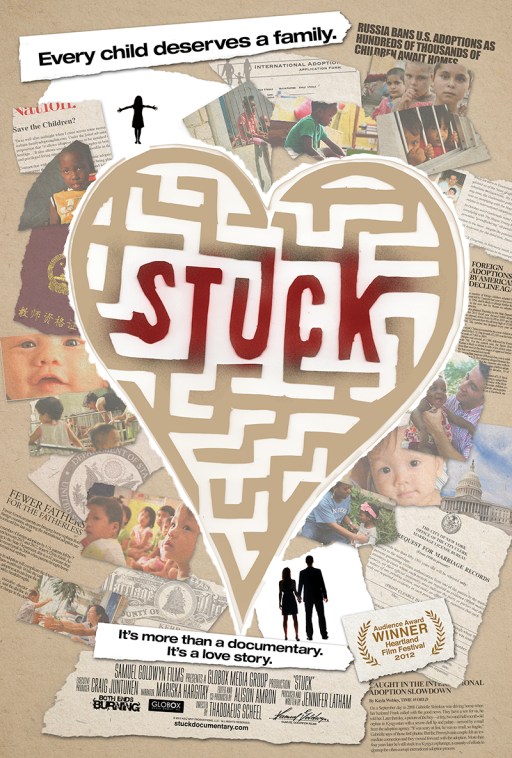
CCAI Featured in Award-winning Documentary Film about International Adoption

STUCK_PosterArt_small

We are proud to announce that STUCK—an award winning documentary about international adoption—features CCAI’s Executive Director, Kathleen Strottman. As Kathleen explains in the documentary, which uncovers the personal, real life stories of adopted children and their parents, “the right to a family is a basic human right and our policies have to start recognizing that.”   The film also features CCA Co-Chair Senator Mary Landrieu, Senator Richard Lugar and Charles Nelson, Co-Principal Investigator of the Bucharest Early Intervention Project.

On March 1st, Both Ends Burning Founder Craig Juntenen will be launching a 60 city bus tour to promote the film and issue a call to action for the United States Government to promote international adoption as a worthy and effective way to find homes for children without families.

To view the trailer for STUCK, follow this link: http://vimeo.com/bebcampaign/stuckthemovie

To learn about how you can help spread the word about STUCK, click here: http://bothendsburning.org/involved/

Family Protects Against Negative Stress

Image Source: The New York Times

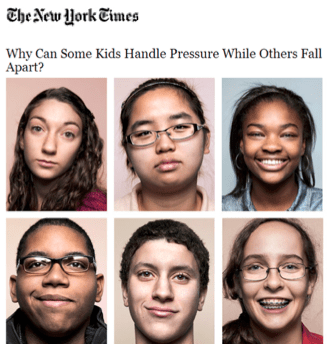
Jacob and Noah Muthler are two brothers from Roaring Spring, Pennsylvania who personify a phenomenon that this weekend’s New York Times Magazine addressed– why can some children take stress in stride while others crumble?

The article highlights the increasing stress that children face, especially because of standardized testing. “The pressure to do well on achievement tests for college is filtering its way down to lower grades, so that even third graders feel as if they are on trial.”

As a test approaches, Noah panics. According to his mother, “he was crying in my arms the night before the test, saying: ‘I’m not ready, Mom. They didn’t teach us everything that will be on the test.’ ” The night before the examination, Noah couldn’t sleep; the only way he would go back to bed is if his mother lay with him.

His brother, Jacob, however seems un-phased by the stress; in fact, he is so unnerved by taking the standardized test that his mother started to worry that he didn’t care about his performance.

It turns out, reactions to stress are partially genetic.  An enzyme responsible for removing dopamine from the brain can affect a person’s ability to cope with stress. Stress floods your brain with dopamine and how quickly the enzyme is able to rid your brain of the excess dopamine determines a child’s natural ability to handle stress. Jacob and Noah prove that even in a family of brothers, the speed of this enzyme can be drastically different.

Still, for those with a slow moving enzyme, all is not lost. Researchers have shown that stress does not always have to be a bad thing.  Jeremy Jamieson, an assistant professor of social psychology at the University of Rochester, believes that people’s negative labeling of stress is the detriment – not the stress itself.

Jamieson believes that if stress is harnessed and viewed as a motivating factor, it can actually improve performance. Jamieson cites the performance of athletes and that the stress they feel before a game fuels their competitive edge.

Maybe Jamieson is on to something; however, for many children this positive outlook on stress is not natural and will need to be coached. For kids like Noah that coach is his mom. She is the one who tells him that the test is no big deal; she reframes it as an opportunity to display his intelligence and acumen, both of which he has proven at school as a student in the gifted and talented program.  And for those times when that perspective isn’t enough to calm him, it’s Noah’s mom who rubs his back and lays with him so he’ll fall back asleep.

What the Times article did not address the issue of children who may not have the appropriate support structures, including those in foster and congregate care and individuals who spend their entire childhood in institutions. Harvard University’s Center on the Developing Child has concluded that in regards to stress, when “buffering relationships are unavailable to the child, the result can be damaged, weakened systems and brain architecture, with lifelong repercussions.”

Some of our most vulnerable children – those living outside of family care who do not have a parent to coach them through stress – are the same children who likely have so much more to worry about: Will I ever be adopted? If I change foster care placements, will I have to change schools as well? Who will help me with my homework? Where are my siblings living and when can I see them again?

Fortunately for Noah, his mom found a solution to rid him of his stress. He will opt out of the Pennsylvania System of School Assessment “using a broad religious and ethical exemption.” Since finding out that he won’t be taking the test, Noah has performed better in school and now looks forward to class.

But for those kids who don’t have a parent to depend on, most of them will be forced to internalize their stress without the benefit of having mom or dad to rub their back and tell them that everything will be okay.

The stress that Noah experiences from standardized testing is legitimate and powerful; no one can dispute that.  But this article neglects to address how those stress-prone children like Noah fare when don’t have an established support system like his.

And  having a safe, loving, permanent family should not be something that any child should ever have to stress about.

CSPAN’s Washington Journal Features CCAI

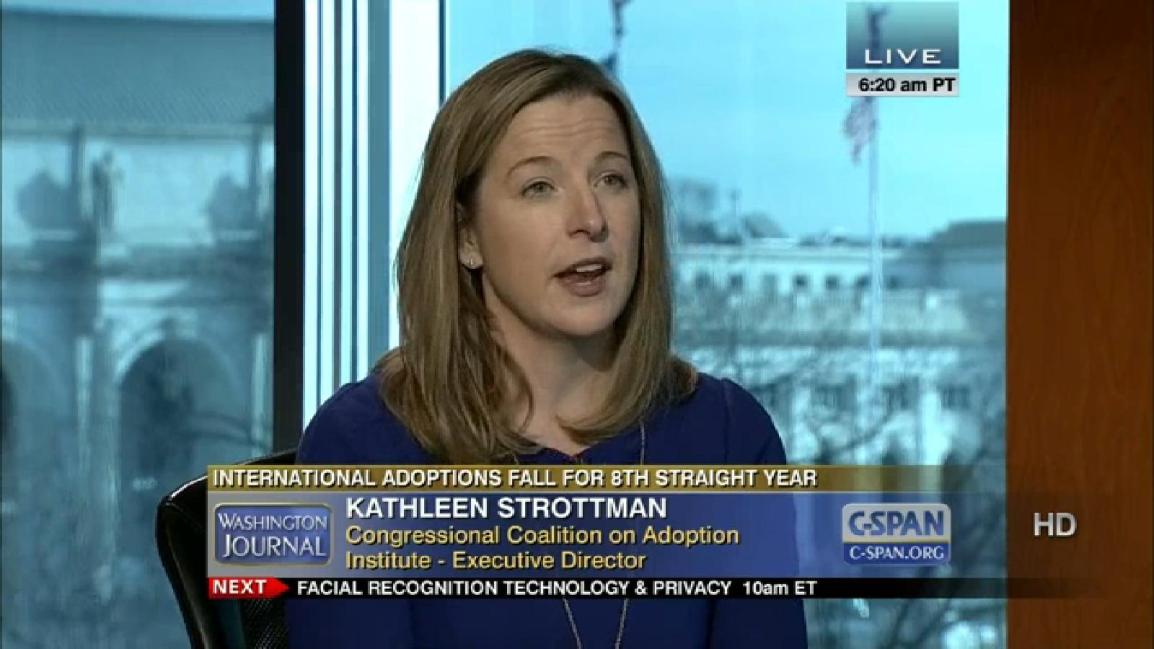
Kathleen_CSPANOn Saturday, CSPAN’s Washington Journal interviewed CCAI Executive Director, Kathleen Strottman, about the Russian adoption ban, international adoption, and how Members of Congress can affect adoption and foster care issues. Click on the picture to watch the full interview or follow this link: http://www.c-spanvideo.org/program/310768-5