CALL TO ACTION: IT’S TIME WE DEMAND A FAMILY FOR EVERY CHILD

In April of this year, at little girl named Daria, who would have turned 3 in May, died from an undiagnosed heart ailment in her orphanage in Nizhny Novgorod, a city about 250 miles east of Moscow.  While the death of any child is a tragic event, what makes Daria’s passing all the more heartbreaking is that she died alone, instead of in the loving arms of her American family that had hoped to adopt her but couldn’t because of the Russian adoption ban.  When I heard the news that a waiting child had died, I could not help but cry.  My tears were for the life she would never live, but they were also for the thousands of other children who, like Daria, have had their lives ended by the stroke of a government’s pen. Over the last ten years, children in Russia, Guatemala, Kyrgyzstan, Vietnam, Haiti, Kazakhstan, Nepal, Ghana and Rwanda have lost the right to find a family through international adoption.

As if this is not enough to invoke tears, countries that close their doors to international adoption too often struggle to provide family based alternatives for their children.  They soon realize that it takes time and resources to build a child welfare system in which families are able to stay together and provide alternative loving homes for children whose families’ were not.  Some never get to the point of realizing that truly protecting a child’s right to a family requires both legal and cultural change.  And so it is that millions of children are condemned to life in prison for the simple crime of being born.

For fifteen years, I have had the honor of fighting for these children in Congress.  I have begged people to consider the fate of the hundreds of Cambodian children whose families were ready to care for them, I have cried with the families whose children were trapped in Guatemala and have flown half way around the world to implore the Government of Vietnam to provide their children with all options for finding a home.  But we cannot keep fighting this battle a country at a time.

Image

I have also read everything I can find on how human relationships affect human development, especially in early years.  It is amazing how much scientific evidence there is to support the notion that children not only deserve a family, but they NEED one.  Children who have a secure, stable relationship with a parent thrive, and those that are deprived of this type of relationship deteriorate.  It is really that simple.

For these reasons, I am convinced the time has come for all those who believe in their core that children have a basic human right to a family to stand up and be heard.  If we don’t, there is no doubt in my mind those who have obscured the world’s view on international adoption will succeed in eliminating it as an option and most governments will just continue to rely on orphanages to raise their children.  Scarier still, we will continue down a path which ends with tens of millions of children whose development has been hindered: making them more likely to engage in crime than finish school, more likely to be a government dependent, than a productive member of society.

This week Senator Mary Landrieu and Senator Roy Blunt called on Congress to change the way the United States Government views the welfare of children abroad.  Their vision is to move the United States away from a system that views children as an immigration enforcement issue to a system that embraces the opportunity to protect their right to be safe from abuse and to be loved by a family.   Their bill, Children in Families First, would align the United States Government’s efforts around what most Americans agree is a core value of our society: family.

For those of you who have not spent the last fifteen years working on adoption issues, let me try and summarize what this bill does.  Right now, neither the State Department and the USAID, which are the two agencies responsible for advancing child welfare issues abroad, have a high level office that focuses on the welfare of children.  At State, if a child is a refugee, they would be covered under the Bureau that addresses refugee issues; if they are a victim of trafficking, they may benefit from the work done by the Office to Combat Human Trafficking and so on.  The same is true at USAID, if they are in need of immediate health care, they will likely get this assistance from the Maternal and Child Health Integrated Program, if they are a victim of AIDS, and their assistance will be spearheaded by the Office of the Global AIDS coordinator.  And if you are a child who is outside of family care, you better hope you fall into another covered category because otherwise no one in our government is responsible for developing policies and programs on your behalf.

Image

You do not need to be a policy expert to appreciate the flaws in such a system.  Practically speaking, what this means is that a United States Ambassador working in a country like Vietnam might know very well what the USG could do to help reduce the number of children living outside of family care in Vietnam, but he has no counterpart in his own Department to turn to for assistance and no resources at USAID dedicated to such work. As we well know, a common reason given for suspensions and closures of international adoption is the need to create better systems for safely and ethically processing adoptions, a need that cannot be met on a wide scale basis without US leadership and support.

Let me be clear, while the bill is calling for a new approach and clear leadership on behalf of parentless children, it is not suggesting we increase the role or size of the federal government. Since it is Fall, let me use a football analogy to explain this further. CHIFF is not saying we need another tight end  or a receiver. It is saying that if you think you can win a football game without a quarterback, you are sorely mistaken.  Under the current structure, we are without the leadership needed to help protect children who need our protection.  As a result, we are throwing incomplete passes instead of making touchdowns.

And finally, why should you care?  If you are reading this and you care about the welfare of children who have no families, for whatever reason, we need you.  Battles in Washington are won when a group of convicted people use a unified voice to call for change.   If we do not speak out now, I am not sure we will have the opportunity to do so again, the battle will be lost, and the children like Daria will continue to die alone instead of in the loving arms of a mother.

Don’t waste one more minute – visit www.childreninfamiliesfirst.org and learn what you can do to make a difference.

Image

Kathleen Strottman with son Noah

A Shift in Americans’ Attitudes about Foster Care Adoption

At CCAI, we believe that one child without a family is one child too many.  Right this very minute, more than 100,000 children in the United States’ foster care system are waiting to be adopted.  Last year, nearly 30,000 foster youth turned 18 and emancipated from care without the families they need and deserve.

In an ideal world, the general population would be well informed before developing opinions about important issues such as child welfare. The reality is, however, that most people gather their information from hearsay or biased media outlets. Television shows like NBC’s The Office or Fox’s The O.C. portray foster youth in a wide spectrum of abnormalities, ranging from slightly weird to unstable to dangerous or unmanageable. As a result, many potential candidates for foster parenting opt for other adoption options because they believe that fostering a child would be too difficult. Tragically, their mistaken views add to the growing number of children left without families.

The Dave Thomas Foundation for Adoption partnered with Harris Interactive to conduct the 2013 National Foster Care Adoption Attitudes Survey to more than 1,400 American adults to gain a broader understanding of their attitudes concerning adoption. With this survey, a follow-up to a similar survey taken in 2007, the Foundation hoped to “better understand Americans’ attitudes about foster care adoption, their belief about the children waiting to be adopted and their perceptions of the foster care system.” Just recently, they released the findings of the survey to the general public, which can be viewed here.

???

Among the survey’s main findings:

  • While 51 percent of those surveyed agreed with the statement that all children are adoptable, only 27 percent of those surveyed would consider adopting a child 12 and older.
  • Many American adults still believe that “the foster care adoption process is overwhelming and expensive.”
  • 43 percent of adults said, based on what they had heard or seen, that it was either very difficult or extremely difficult to adopt a child from foster care.

This survey comes six years after DTFA’s initial survey.  The most notable change in attitudes between then and now is that a greater number of Americans understand that children who are in foster care are the victims of abuse and neglect, not dangerous delinquents.  In 2007, 59 percent of respondents thought children adopted from foster care were more likely to have problems with behavior and self-control. In 2012, the number fell 13 points to 46 percent.

So what does all this mean for policymakers?  Below are just a few current policy areas which might help to address the issues identified by the survey.

  • Adoption Tax Credit:  While the process of foster adoption is actually very inexpensive, there are costs which come with raising a child who is adopted from foster care.   According to the 2007 National Survey of Adoptive Parents, only one quarter of individuals who adopt children from foster care have incomes greater than $87,000. Without the support of a refundable credit, the majority of adoptive families might not be able to afford such costs and worse, the fear of not being able to meet them, might deny a child a family. As Congress continues to consider tax reform, it is essential that they understand the importance of continuing to provide a refundable adoption tax credit for families. 
  • Post-Adoption Services: Adopting from foster care can be one of the most rewarding experiences of a lifetime.  But those who have done it will tell you that raising a child who has experienced early trauma is not without its trials.  For adoption from foster care to be the lifelong commitment it is meant to be, it is important that families have access to post-adoption services.  Despite their critical importance, there is little to no dedicated federal funding for post-adoption services.
  • Adoption Incentives:  As the survey indicates, the hardest to place children are often children older than 12.  States who are using traditional child-recruitment strategies are not likely to be successful in finding these children homes.  Although the current adoption incentive program doubles the incentive for placing older youth, a child over nine is half as likely to find a home through adoption.  Federal policymakers need to consider how to incentivize the use of child-focused recruitment models, such as Wendy’s Wonderful Kids, to provide a loving home for every child in need.

For the purpose of this post, CCAI only used a portion of the information resulting from the survey. The complete 2013 National Foster Care Adoption Attitudes Survey can be found here.

CCAI Guest Blog Post: How DOMA Impacts Adoption

Athena Madison
Athena Madison

By Athena Madison

All I have ever wanted was to be adopted.

I have been in and out of the foster care system since I was eight years old. My mother passed away when I was seven and my father sulked in depression so much that he forgot he had kids and we became collateral damage. I became a mother to my siblings at a very young age.  My whole life, I have been an adult. I never had a childhood nor was I ever given the chance to be a teenager; I was too busy fighting off the sexual advances of my father’s drunk friends.

I never had parents although I have always wanted some. I still want a family, but at the age of nineteen, no one will adopt me. Every adult that I have met has said, “I’d adopt you in a heartbeat” but no one has ever followed through. That was always the worst feeling –to give me a bright red balloon and then in that same second pop it.

When I was fourteen, my mentor seriously considered adopting me. I cried tears of joy thinking about that possibility, a home, warm meals and a bed –the kind of safety that said I was going to be okay. She researched the possibility and what it would entail. Unfortunately what she learned was she shouldn’t bother trying; she wouldn’t be allowed to adopt me because of her sexual orientation.

I felt the pain and she felt the pain. The tears, anger and frustration held me hostage when I realized I was being denied a happy home with the only person I had ever trusted. I was being denied of a better life, because of logic that was simply discriminatory. The injustice overwhelmed me. I mourned. I have since mourned the life I could have had.

This summer, I am one of 16 individuals participating in CCAI’s Foster Youth Internship (FYI) program. As part of the program, we are asked to develop a Congressional report and propose a specific policy recommendation that would improve the child welfare system. I plan to present policy recommendations that remove barriers to individuals who are gay or lesbian adopting nationwide. No child should mourn a life they could have had.

This past Wednesday, the Supreme Court made a monumental step in the right direction when they struck down the Defense of Marriage Act.  In doing so, they recognized a simple fact:  that the law is meant to protect all people equally.  I think that people who are gay and lesbian should have equal rights both as spouses and as parents.

There are thousands of gay and lesbian parents who provide safe and loving homes. Words will never truly explain how much I would have picked two loving mothers or two loving fathers over being homeless and without anyone to claim me as their own. I believe that there is not a child in this country that would say “Oh! Can I have that parent there? Yes, the straight one to your right.” No child would turn down the opportunity to have a family to call their own. It’s about time we had some change.

Athena is one of 16 Foster Youth Interns who will be presenting her policy recommendations at a Congressional briefing on Tuesday, July 30. 

CCAI Statement and Summary Regarding Supreme Court Ruling in Adoptive Couple v. Baby Girl

Veronica
Veronica

CCAI Executive Director Kathleen Strottman’s

Statement Regarding Supreme Court Decision in Adoptive Couple v. Baby Girl

“Through my work with current and former foster youth, I have learned that having a strong sense of one’s culture, heritage and identity is a vitally important part of child and adolescent development. It is for this reason that CCAI has continued to work to ensure that these components are not only recognized but protected by the United States child welfare system.  The Indian Child Welfare Act is an important piece of federal legislation that, when well implemented, carefully safeguards the best interests of Native American children.

 It has been over 25 years since the Indian Child Welfare Act was enacted into law.  In recent years, the media and tribal community have rightly pointed to the disproportionate number of native youth in care as evidence of its continued need.  At the same time, child welfare advocates have pointed out cases in which application of ICWA is resulting in native children being denied a safe, loving and permanent family through adoption.  I sincerely hope that today’s decision sparks a necessary and open discussion of ways that this critically important law might be used to better protect the best interests of children.”

CCAI Summary Regarding Supreme Court Decision in Adoptive Couple v. Baby Girl

The Supreme Court of the United States ruled 5-4 in favor of the adoptive parents of “Baby Veronica” in Adoptive Couple v. Baby Girl and reversed the decision of the South Carolina state court that removed the child from the adoptive parents’ home at the age of 27 months and placed her with her biological father, a member of the Cherokee tribe, whom she had never met.

The Supreme Court’s decision held that the provisions of the Indian Child Welfare Act (ICWA) that the state court relied upon in its decision do not apply to the facts of this case.  Specifically, the Court found that ICWA “was designed primarily to counteract the unwarranted removal of Indian children from Indian families. But the ICWA’s primary goal is not implicated when an Indian child’s adoption is voluntary and lawfully initiated by a non-Indian parent with sole custodial rights.”

The Court stated that the biological father abandoned the child before birth and never had “continued custody” (legal or physical) of the child so there was no relationship that could be discontinued by terminating the biological Indian father’s rights to the child.

The Court also held that ICWA’s adoption placement preferences for Indian families do not apply in this case, because the biological father and extended family did not seek to adopt the child.

 ###

Supporting Adoption Placements in Hospitals

CCAI Angel in Adoption Rebecca Vahle
CCAI Angel in Adoption Rebecca Vahle receiving her award from Congressman Coffman

CCAI Angel in Adoption, Rebecca Vahle, is an Adoption Liaison at Parker Adventist Hospital where she works on the Family to Family Adoption Support program. We asked Rebecca to write about why she decided to start this initiative and her experience with the program.

The Family to Family Adoption Support program at Parker Adventist Hospital in Parker, CO, just southeast of Denver, is the only established and comprehensive hospital-based adoption support program in the nation.  Over the past eight years, our goal has evolved and expanded.  The program’s core mission is to ensure that mothers who desire to make an adoption plan have access to trained nurses and doctors during this emotional and complex time.

As an adoptive mom, I have welcomed two of our children home as infants. Both hospital situations, while very different, were extremely emotional and unnecessarily chaotic.  It was evident that the staff had a wide range of opinions about adoption, and the hospital policies were unclear.

After our two experiences, I started talking to other adoptive families and birth families.  I found that hospital placements were described by all families involved as wonderful, horrible, humiliating, shame-filled, beautiful, etc.  And sadly, some of those words, such as wonderful and shame-filled, were used to describe hospital placements at the same facility, all dependent on the “nurse you got” or if a staff member had a positive or negative adoption experience.  I also heard from nursing staff that they felt uncomfortable since they didn’t have any formal training as to how to best handle the complexities of an adoption placement.

We started our program in 2005 with mandatory training for our staff, and in time, training for our doctors.  Little did we know that the program would evolve to a service and support model that included education for those both considering adoption and preparing for an adoption, as well as awareness of post-adoption resources.

As the only hospital in Colorado that offers services to all members of this population, our outreach efforts also include adoption education throughout the community.  A clear understanding of adoption has allowed us to help women like Karen*.  Karen was driving through the Denver area on her way to her home state when she went into labor.  Her contractions got too strong for her to continue, and no one back home knew she was pregnant.  She followed the “H” signs on the road and entered Parker Adventist Hospital in the early morning hours.  She told the nurse her plan: to leave once the baby was born and give the baby to the state.  The nurse, trained in adoption, simply mentioned that she could choose to do an adoption plan instead, and that she could choose an agency and meet with a counselor. She was made aware that she could pick a family, even meet them if she’d like, and would still be able to leave that day.  After choosing the family for her child after delivery, she told me, “I had no idea!  I didn’t even know this was an option.”

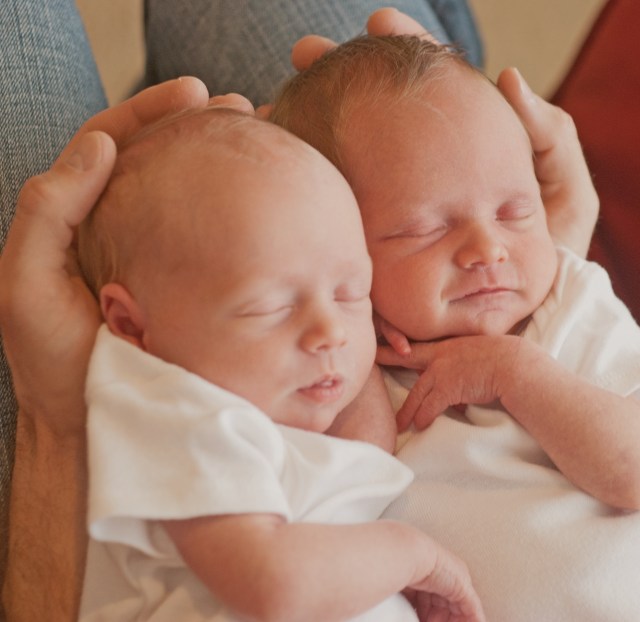
Twins born at Parker Adventist Hospital and later adopted because of the Family to Family Adoption Support program.
Twins placed for adoption at Parker Adventist Hospital.

Sometimes we get connected with patients considering adoption early in their pregnancy.  We are able to connect them with adoption-sensitive doctors who are aware that they are simply considering adoption and that their care will continue with that doctor regardless if they choose to parent or make an adoption plan.  This is beneficial as they do not have ER deliveries, but are offered consistent prenatal care and ongoing support regardless of their ultimate decision.

Another recent patient didn’t have much warning and also came into the Parker BirthPlace ready to deliver.  She, however, announced when she came in that she was planning to do an adoption.  She had been living in her car and had not been able to meet with a counselor.  She was able to step into a program in the BirthPlace that understood her wishes and had the resources and infrastructure to meet her needs.  She told me, “It was just really important to me that she not go into foster care. I really wanted her to go straight to her family.”  This time in the hospital would hopefully be the beginning of a lifelong relationship with her adoptive family.  We are so honored to share this precious time with our patients and the families involved.

Imagine how the adoption community would be different if there was a Family to Family Adoption Support program in every hospital?  What if nurses and doctors felt empowered to care for their patients in a way that honored their decisions? What if hospital professionals clearly understood their adoption policies and guidelines and had an opportunity to explore their own thoughts about adoption?  What if there was a place for families to go where they could receive care from healthcare professionals who better understood the logistical complexity and emotional impact of an adoption plan?

I was asked recently why a hospital wouldn’t have a program like this one.  I believe there are two reasons:

 Hospitals don’t believe they see “enough” adoptions to fund mandatory training.  I would challenge that with this fact: we were seeing an average of one adoption a month when this program was first launched in 2005.  In 2013, we started off the year by having seven babies placed in seven weeks, serving patients ages 14-42.  The mother of a 14 year-old patient told me, “Without Parker Adventist Hospital, we would be taking this baby home.  Not because she is ready to be a mom, but because we wouldn’t have even known where to start when considering adoption.”  One of our doctors told me, “I now do not hesitate to discuss the option of adoption with my patients.  If they want more information, I know I can send them to the Adoption Liaison.”

Hospitals don’t recognize how much adoption has changed.   In the “old model”, the hospital stay was very different.  A woman delivered a baby, the baby was taken out of the room and given to a social worker, who then delivered the baby to his or her new family.  The mother was told to forget about the baby she just delivered and move on.  The adoptive family was coached to not address the child’s loss of his or her first family.  This approach is contrary to the model we embrace at Parker Adventist Hospital.  With the changes toward open adoption, our program embraces the patient and supports her with compassionate care while acknowledging her loss.  We also recognize that the extended family will naturally be affected by the adoption and may be present. The patient and her family are encouraged to define the woman’s time in the hospital, and if the baby’s father is present also, we do our best to support his unique emotions as well.  Our goal is to support that baby’s parents with not only excellent medical care but also compassionate emotional support.

I truly believe we must challenge our hospitals to do three things: become knowledgeable about adoption issues, require mandatory training regarding current adoption practice, and learn  how professionals can best support patients during their hospital time, empowering them to make the choice that is best for them.   As we see our community utilizing our Family to Family Adoption Support program at Parker Adventist Hospital, we see how having adoption-sensitive care and providing adoption resources can change the community’s approach and understanding of adoption.

For additional information regarding the Family to Family Adoption Support program or to explore upcoming training opportunities, visit www.parkerhospital.org/adoptionsupport  or contact Rebecca Vahle, Adoption Liaison in the Parker BirthPlace, at rebeccavahle@centura.org.

*Name changed

Punching Holes in the Darkness: U.S. Foreign Assistance for Children in Adversity

Come Share Your Dreams
Photo Credit: Christian Alliance for Orphans Summit 9
May 3, 2013 Nashville, TN

As a boy, renowned author Robert Louis Stevenson lived on a hillside in Scotland, his family’s home overlooking a small town below. Robert was intrigued by the work of the old lamplighters who went about with a ladder and a torch lighting the street lights for the night. One evening, as Robert stood watching with fascination, his parents asked him “Robert, what in the world are you looking at out there?” With great excitement he exclaimed, “Look at that man! He’s punching holes in the darkness!”

Three years ago, CCAI set out to punch holes in the darkness. Frustrated by the fact that the United States Government, a leader in so many other areas of global concern, lacked a clear and effective strategy for reducing the number of children living without the support of a family; we started by asking why? Why was it that a value so clearly a part of the U.S. Government’s efforts to protect children had not made it into our foreign policy?  Why was such a fundamental American value, the value of family, not better represented in our programming abroad?

The more we learned, the more our concern grew. We learned that while an estimated $2 billion dollars a year was reportedly being invested in international programs focused on the care and support of orphans, little to none of this funding was being spent on preventing orphanhood. We learned that despite overwhelming scientific evidence that institutions seriously damage children, our lack of advocacy for family based care was resulting in an increasing number of children being confined to a life in them.  And perhaps one of the hardest lessons we learned: despite national experience with international adoption as a worthy and effective way of securing a safe and stable family, we watched as global leaders suggested otherwise.

And so we had a choice to make. We could stand idly by and allow the futures of millions of children be cut short by this darkness or we could punch holes in the darkness in the hopes that bringing light to these issues would inspire change. We chose the latter.  We began by educating federal policymakers on what emerging brain science tells us about how urgent the need is for global policies to better reflect the right to a family as a basic human right.  We also outlined how U.S. policies, programs and priorities might be improved to better protect this fundamental right. Finally, we hosted two national and one regional convening to engage foreign leaders in a concrete conversation on moving their child welfare systems away from orphanages and toward families.

Our Haiti Convening illustrated that it is not only possible but preferable for the Government of Haiti to focus on rebuilding its families instead of rebuilding its orphanages. Our Way Forward Project sought to stimulate dialogue among the world’s experts on both the need for family-based care but also the ways in which laws, policies and programs might be developed or expanded to support the use of family-based care for children in need of it.  And most recently, our Pathways to Permanency Project provided permanency training for 15 key leaders from Guatemala.

Today, the U.S. Senate Committee on Appropriations Subcommittee on State, Foreign Operations and Related Programs held a hearing on the newly launched USG Action Plan for Children in Adversity (APCA).  In providing testimony to the committee, Deputy Administrator Donald Steinberg acknowledged that APCA is the first ever high-level USG policy that acknowledges that children need families to thrive.  He also acknowledged that the Action Plan is a critical realigning of U.S. investments in children abroad around three key objectives, the second of which is to reduce the number of children without families.

Today, Mr. Stevenson, I felt like that lamplighter.